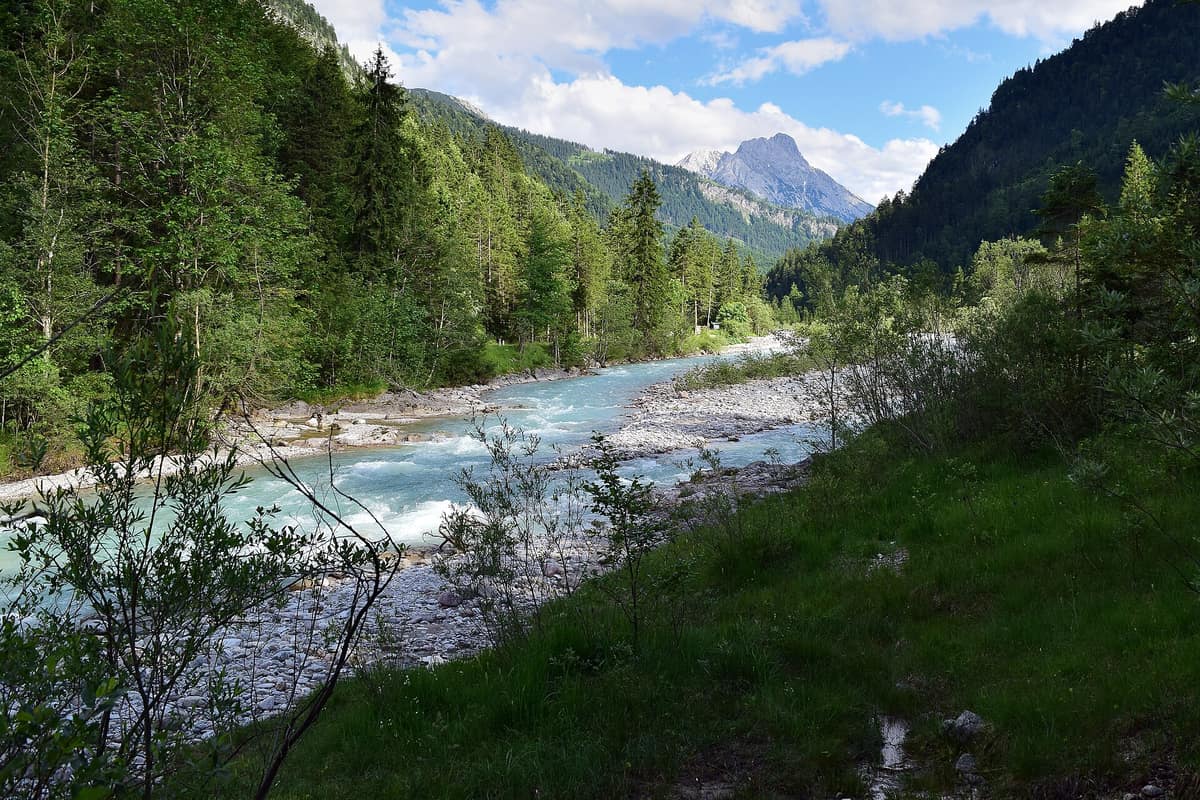
Karwendel Nature Park
Naturpark Karwendel
Tyrol (Innsbruck / Scharnitz) (AT) / Bavaria (Mittenwald) (DE) · Austria / Germany
Photo: Haeferl · CC BY-SA 3.0 at · Wikimedia Commons
Tyrol's largest Nature Park, with 4 parallel limestone ranges plunging sheer into gorges and the famous ancient sycamore-maple wood-pasture Großer Ahornboden.
During the Thirty Years' War, livestock ceased ascending to the Eng, perhaps out of fear of plunder or because of famine. Young sycamore maples grew untouched by grazing teeth, and today more than 2.200 trees grace the Ahornboden. That maple forest is the emblem of a colossal protected landscape: Naturpark Karwendel spans almost the entire Karwendel massif and the Arnspitze reserve, covering 739 km², making it Austria's largest nature park and Tyrol's oldest and most extensive protected area.
What makes it unique
The Großer Ahornboden is the largest concentration of mountain sycamore maple wood-pastures in the entire Alpine arc.
The place
Nature
The landscape
The Karwendel is a sheer wall of limestone. Belonging to the Northern Limestone Alps, the massif consists of four major east-west chains, stretching some 45 km lengthwise and nearly 30 km from north to south. It is sculpted from Wetterstein limestone and dolomite, folded toward the south: on the Laliderer Wände, the northern face forms vertical precipices plunging up to 1.000 m, whereas the gentler southern flanks were gouged by glaciers into broad cirques flanked by formidable ridges. The colossal rock faces framing the Ahornboden tell the story of ancient tropical seas and towering sheets of ice.
Water completes this dramatic canvas. The Isar rises in the Hinterautal, and its dynamic gravel-bed river system retains an exceptionally high degree of naturalness for Central Europe. Along the gravel banks of the Rißbach and upper Isar thrive German tamarisk, the spotted bush-cricket and the common sandpiper.
The Ahornboden owes its existence to distinct geological processes. For centuries, the Rißbach inundated the valley floor, depositing gravelly, nutrient-poor alluvium ideal for mountain maple but inhospitable to fir and spruce. That is why the sycamores of the Eng, some reaching up to 600 years of age, flourish right where they stand.
Wildlife and seasons
This is a realm of eagles. The golden eagle claims undisturbed cliffs for eyries and hunts across open alpine terrain above tree line, with park management aiming for a baseline of at least 14 breeding pairs; this entails safeguarding nesting cliffs, managing rock climbing routes and banning lead ammunition. The white-backed woodpecker depends on natural, deadwood-rich deciduous stands, with conservation targeting more than 50 pairs across the Bächental, northern Achental and Rißtal, Stallental and Vomper Loch. In total, 96 breeding bird species have been recorded on the Austrian side, roughly two-thirds of Tyrol's entire avifauna.
High cirques regularly host large herds of chamois. The Alpine ibex was successfully reintroduced around the Sonnjoch and the Nordkette; it is also seen in the rugged cirques of the Mondscheinspitze range. Alongside Alpine marmots and soaring eagles, they complete a quintessential scene of alpine meadows. Above the Soiern lakes, the Alpine salamander is frequently encountered during damp conditions.
The lady's slipper orchid is the largest native orchid, growing up to 60 cm tall; dependent on mycorrhizal soil fungi, it must never be picked or uprooted. The ideal visiting window runs from June to October, with moderate autumn visitor numbers drawn to the turning foliage of the Ahornboden.
Species
With a page in the atlas
Being mentioned in a source doesn't guarantee sightings: check with the people who manage the area.
Memory and protection
History and conservation
Alpine farming in the Eng boasts ancient origins: the earliest known deed dates to 1460, while pastoral grazing likely reaches back to the Neolithic. Mountaineering took off in the second half of the nineteenth century, and today more than 50 staffed alpine huts and rustic dairy pastures welcome visitors.
The park traces its roots to a 1928 nature conservation decree, among the earliest in the Eastern Alps. The Tyrolean sector represents one of the largest protected wilderness tracts in the Eastern Alps, encompassing 727 km².
Before you set off
Visiting
How to visit
The main gateway is Hinterriß, the sole year-round settlement within the massif. From there, the Enger Grund is the classic family excursion: from the car park at Alpengasthof Eng, a themed nature path leads to the Engalm at 1.227 m, Tyrol's oldest mountain dairy pasture, while a wide, gentle trail continues to the head of the valley. It takes an hour and a half, is easy and suitable for children, with a playground at the Engalm. The Eng nature trail explains mountain sycamores, conservation efforts at the Ahornboden and alpine pastoralism past and present. Summer bus shuttles run from Bad Tölz and Lenggries to the car park.
To learn more, the Naturparkhaus in Hinterriß and the information centre in Scharnitz illuminate the landscape, history and wildlife. Further museums and educational routes include rundumTHAUR, Museum Holzerhütte and the Naturraum Karwendel display at Umbrüggler Alm. Guided stargazing sessions are also offered in the dark skies of the Ahornboden. Park rangers have been active since 2010, monitoring indicator species and vulnerable habitats.
For seasoned mountain trekkers, the Adlerweg (Eagle Walk) traverses Tyrol through the park: featuring 33 stages, 413 km and 31.000 m of cumulative ascent, with seven stages crossing the Karwendel. These routes demand alpine experience, sure-footedness and a head for heights.
Before you go
Visitors are urged to be quiet observers: do not harvest mushrooms, berries or wild plants, avoid excessive noise, leave no litter and keep dogs on a leash. From 15 April to 15 August, paddling or boating on the Rißbach between Hagelhütten and Neunerbrücke and stepping off marked tracks in the Rißtal are forbidden to safeguard nesting common sandpipers. Wild camping is strictly prohibited everywhere outside designated commercial campsites, including throughout the Karwendel: sleeping in tents, bivouacs or vehicles is forbidden.
Check access, rules and visiting conditions in the official information from the managing body before you set off.
Location
Where it is and how far it reaches
Boundary of Karwendel · IUCN V · © EEA, CDDA (CC-BY) The coordinate is estimated; it isn't a verified access point.
Transparency
Sources
The research data with its sources, and the official links for this place, are in the Spanish version of this page. See the Spanish version
Around it
The Rofangebirge - Brandenberger Alpen partially borders the park. Further afield, destinations sharing ibex, golden eagle and chamois include Parco Nazionale Gran Paradiso, Schobergruppe - Hohe Tauern, Nationalpark Hohe Tauern - Umbaltal & Isel and Parc national de la Vanoise.
If you like this place, elsewhere in Europe
Distant places with uncommon wildlife and habitats in common. The most widespread species don't count. Sharing species doesn't imply a corridor or guaranteed presence.
- Dachstein Nature Reserve — Gosau, Hallstatt and Obertraun
Upper Austria — Gmunden; Gosau, Hallstatt and Obertraun
In common: Alpine ibex · Chamois · Golden eagle — high mountain, old-growth forest
Karst topography, glaciers, alpine meadows and old-growth mountain forests above the Gosau lakes.
JFMAMJJASONDMarch – November · Crowding no data
- Maritime Alps Natural Park
Piedmont (Cuneo / Valdieri / Entracque)
In common: Alpine ibex · Chamois · Golden eagle — high mountain, old-growth forest
United with France's Mercantour National Park, it forms a massive cross-border Alpine-Mediterranean wilderness crowned by Mount Argentera (3.297 m).
JFMAMJJASONDJune – October · Crowding low
- Gran Paradiso National Park
Aosta Valley / Piedmont (Cogne / Valsavarenche / Ceresole Reale)
In common: Alpine ibex · Chamois · Golden eagle — high mountain, old-growth forest
Italy's oldest national park (1922): the last surviving Alpine ibex population held out here and repopulated the entire range.
JFMAMJJASONDJune – September · December – January · Crowding moderate
- Écrins National Park - Alpine Massif
Auvergne-Rhône-Alpes / Provence-Alpes-Côte d'Azur (Isère / Hautes-Alpes)
In common: Alpine ibex · Chamois · Golden eagle — high mountain
The glaciated core of the French Alps (Barre des Écrins 4.102 m), with deep glacial valleys such as Valgaudemar and Vénéon.
JFMAMJJASONDJune – October · Crowding low
Entry #350 of the original atlas.