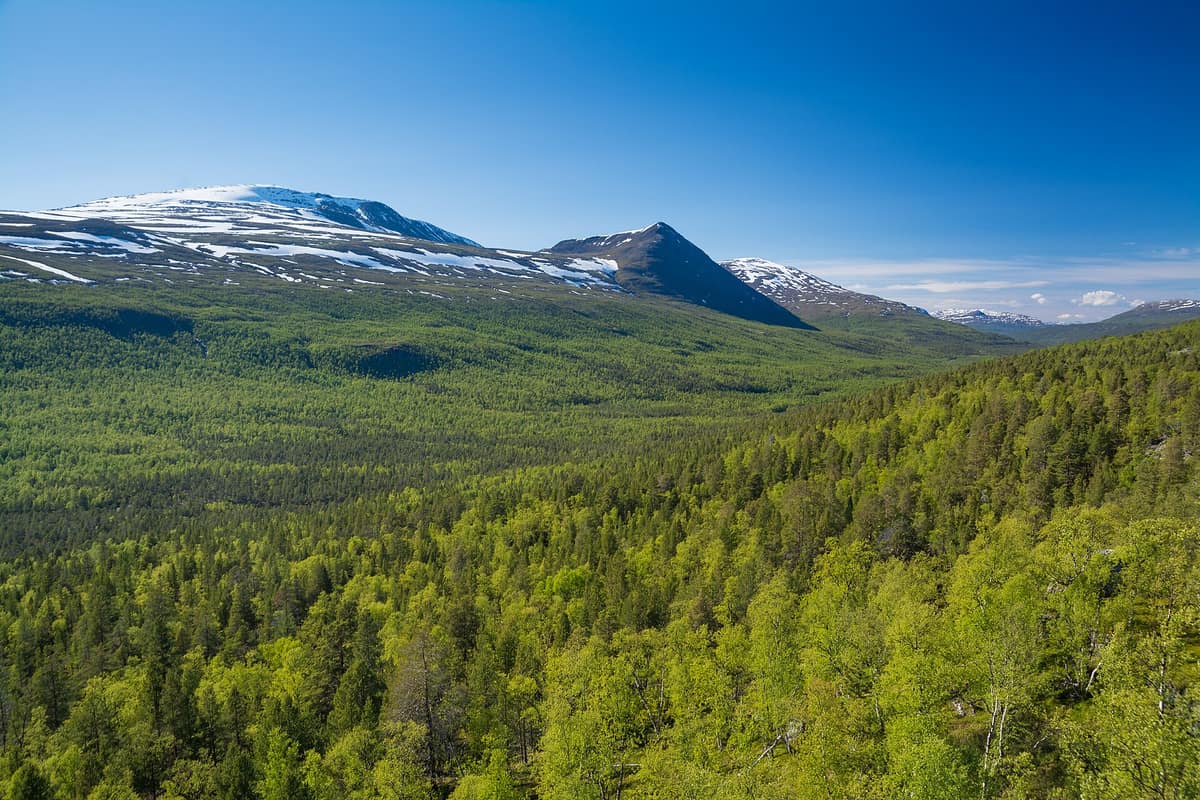
Øvre Dividal National Park
Troms (Målselv / Øverbygd) · Norway
Photo: Kim Grønbæk Skytte · CC BY-SA 3.0 · Wikimedia Commons
One of the few European national parks where all four large Arctic predators stably coexist: brown bear, wolf, lynx, and wolverine.
In the interior of Troms, hugging the Swedish border, lies a secluded valley harboring one of the densest wolverine populations in northern Europe. Øvre Dividal is a 770 km² park established in 1971 and expanded in 2006 to safeguard a largely undisturbed inland valley and mountain landscape. It lacks the fame of other Norwegian parks, and that is central to its charm: ancient, gnarled pine forests, mountain birch groves, rounded massifs, pristine lakes, peatlands, and deep ravines. Above all, it is the realm of the wolverine.
What makes it unique
Here the wolverine population ranks among the densest in northern Europe, with cubs born every year in numerous dens throughout the park.
The place
Nature
The landscape
The park ascends from around 300 m up to 1.600. Across this gradient the forest terraces with textbook clarity: ancient pine forests at lower elevations, mountain birch higher up, and, across the open alpine tundra, willow thickets and dwarf birch. Along the Divielva river linger ancient stands of old-growth pine and deciduous woods supporting rich flora and fauna, including many rare lichens, fungi, and beetles.
The ground tells a much longer saga. Some 600 million years ago, conglomerates, sandstones, and shales—the Dividal Group—were deposited over a granite basement, and these bedrock layers remain exposed on escarpments such as Bumannsberget. Much later, glaciers of the last ice age stranded erratic boulders on high summits: a massive red granite erratic beside the cairn on the peak of Jerta was transported all the way from Sweden. Several rivers have carved canyons, while across the valley floor colossal boulders lie in improbable spots, deposited at random by retreating ice.
The climate is continental and dry. At 228 m altitude, Dividalen is Norway's second driest valley, receiving just 282 mm of annual precipitation. Low-lying valley floors lack permafrost; above 700 m, it is ubiquitous.
Among plants, 315 species have been recorded. Arctic white heather, which grows only in northern Norway, is abundant, and the tiny Rhododendron lapponicum grows naturally here.
Wildlife and seasons
All four large European carnivores inhabit the park. The wolverine takes center stage: its population is among the densest in northern Europe, and in winter caribou constitutes the mainstay of its diet. The brown bear shares a cross-border population with Sweden, and sows with cubs are sighted almost every year. The Arctic fox and Eurasian lynx are resident, while the grey wolf regularly ranges through the park, though it is scarce and likely lacks permanent pack residency. Reindeer, owned by Sami herders, are common, as is the moose.
Birds arrive with the spring and autumn migrations. Extensive wetlands attract ruffs and red-necked phalaropes alongside numerous duck species. Woodlands teem with passerines and host nesting western capercaillies. Raptors include breeding golden eagles, rough-legged buzzards, gyrfalcons, and kestrels; the snowy owl appears in years of rodent irruptions.
Species
With a page in the atlas
Being mentioned in a source doesn't guarantee sightings: check with the people who manage the area.
Memory and protection
History and conservation
The name Dividal originates from the Sami word dievva, designating a rounded, dry hill. Generations of Sami inhabited the land, leaving sacred sacrifice sites, turf hut remnants, meat caches, and ancient birch reindeer corrals. In the late eighteenth century, Norwegian and Kven settlers penetrated interior Troms; Dividalen was colonized late, and its highest homestead, Frihetsli, was not cleared until 1844. Today, reindeer belonging to the Swedish Sami reindeer-herding districts of Lainiovuoma and Saarivuoma graze the park in summer.
Before you set off
Visiting
How to visit
The Arctic Nordkalottruta trail traverses the park, serving as the spine for long-distance treks; you can pick it up at the end of the Dividalen road or from Innset at Altevatn. For a day trip, less is required: from the trailhead car park at the end of the Dividalen road to the Ole Nergård cabin, onwards to the Dividal cabins, and back. Another short stroll meanders through the gnarled old-growth pine woods, while the canyon of Skakterdalen lies an hour's hike from the road.
Overnight huts are available: the Troms Turlag hiking association cabins (Dividal, Vuomma, and Gaska) and the Ole Nergård cabin, an unlocked Statskog log shelter. Access is via the Dividalen road and a forest track to Skaktarelva (in winter) or Gambekken (in summer), through Rostadalen to Innset and Tverrelvmo, or up to Altevatn.
In autumn, the ancient forests yield mushrooms and berries that you can forage for personal consumption.
Before you go
You may roam wherever you wish on foot or skis, but motorized transport is essentially prohibited. Wild camping is permitted anywhere, provided you pack out all refuse. A general campfire ban in or near woodlands applies from 15 April to 15 September. Dogs are welcome but must be kept on a leash from 1 April to 1 September. Respect reindeer, especially during calving season in May and June.
Check access, rules and visiting conditions in the official information from the managing body before you set off.
Location
Where it is and how far it reaches
Boundary of Øvre Dividal · IUCN II · © EEA, CDDA (CC-BY) The coordinate is estimated; it isn't a verified access point.
Transparency
Sources
The research data with its sources, and the official links for this place, are in the Spanish version of this page. See the Spanish version
Around it
Øvre Dividal has no immediate neighbors in the atlas, yet it shares wolverine, wolf, and brown bear with other northern wildernesses. Urho Kekkonen National Park, Sarek National Park, Hossa National Park, and Femundsmarka National Park all shelter wolverines and wolves, while Urho Kekkonen, Hossa, and Femundsmarka also support brown bears.
If you like this place, elsewhere in Europe
Distant places with uncommon wildlife and habitats in common. The most widespread species don't count. Sharing species doesn't imply a corridor or guaranteed presence.
- Urho Kekkonen National Park
Finnish Lapland (Saariselkä / Inari / Sodankylä)
In common: Wolverine · Brown bear · Grey wolf — primary forest, high mountain, wetland
Finland’s second largest national park (2.550 km²), rounded arctic tundra fell-tops (tunturi), and wild trekking under the shadow of Sokosti (718 m).
JFMAMJJASONDJune – April · Crowding low
- Sarek National Park - Europe's Last Great Wilderness
Swedish Lapland / Norrbotten (Jokkmokk / Kvikkjokk / Ritsem)
In common: Wolverine · Eurasian lynx · Brown bear — high mountain
Peaks, glaciers, and the Ráhpavuobme valley in Sarek National Park, part of the Laponia World Heritage site.
JFMAMJJASONDJuly – September · Crowding very low
- Vindelfjällen Nature Reserve
Västerbotten (Ammarnäs / Tärnaby)
In common: Wolverine · Eurasian lynx · Brown bear — high mountain, wetland
One of the largest nature reserves in Europe: high-alpine massifs, birch valleys, and the free-flowing Vindel River running wild to the Baltic.
JFMAMJJASONDMarch – April · June – September · Crowding very low
- Hossa National Park
Finland (Suomussalmi — Kainuu)
In common: Wolverine · Brown bear · Grey wolf — wetland
Clear lakes and rivers woven between glacial esker ridges and taiga pine forests, featuring rock art on the shores of Lake Somerjärvi.
JFMAMJJASONDFebruary – March · June – September · Crowding very low
Entry #585 of the original atlas.