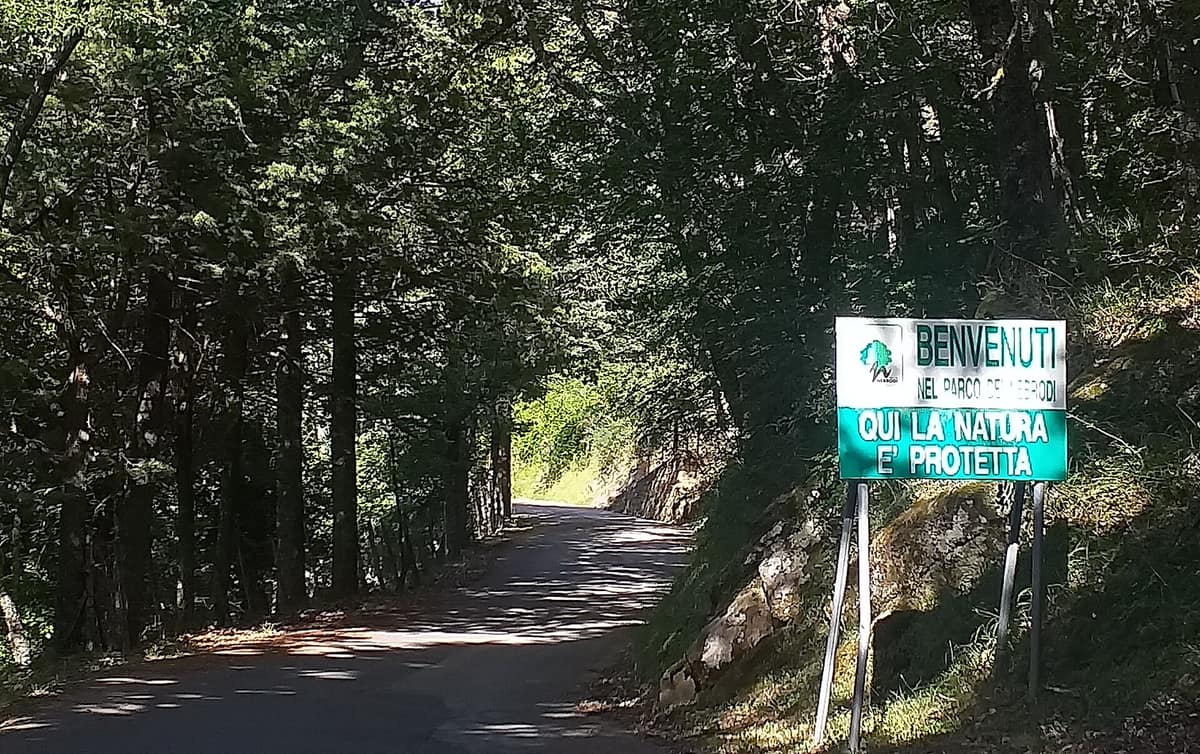
Nebrodi Park (Sicily)
Parco dei Nebrodi
Sicily (Messina / Enna / Catania / Cesarò / Caronia) · Italy
Photo: Cavalloselvatico · CC BY-SA 4.0 · Wikimedia Commons
The largest continuous forest tract in Sicily (86.000 ha), featuring the island's most densely wooded peaks and the spectacular limestone crags of the Rocche del Crasto.
Sicily is far more than blazing sun and smoking volcanoes. In the north of the island between the Tyrrhenian Sea and the northern slopes of Mount Etna rise rolling mountain ridges blanketed in beech, oak, and cork oak, where winter brings snowfall and summer brings cool mountain air. These are the Nebrodi, and the Nebrodi Park, spanning nearly 86.000 hectares, is Sicily's largest protected natural area. Its name derives from the Greek nebros, «fawn», and to this day this remains the island's richest haven for wildlife.
What makes it unique
At Mangalaviti, high-altitude beechwoods mingle with maples, ashes, hollies, yews, and crab apples, with the European beech reaching its southernmost limit here.
The place
Nature
The landscape
The Nebrodi, alongside the Madonie and Peloritani ranges, form the Sicilian Apennines. Rising from just tens of metres above sea level up to 1.847 metres on Monte Soro, this elevation gradient structures the whole landscape. The lowest tier is coastal: up to 700-800 metres thrive cork oak groves and Mediterranean scrub of tree heath, strawberry tree, myrtle, mastic, and holm oak. Higher up between 600 and 800 metres, cork oak forms ecologically exceptional associations in Caronia. Above that elevation reigns the European beech, which reaches the southernmost boundary of its global range on these peaks.
The underlying geology also shifts character. Summits are generally soft and rounded owing to prevailing clays and sandstones, but where limestone dominates, the relief turns dolomitic, jagged, and deeply fractured: Monte San Fratello and, most dramatically, the Rocche del Crasto, a rare occurrence of dolomitic crags in southern Italy.
The climate rounds out the picture. Dense woodlands foster relatively prolonged, cold winters where temperatures rarely plunge below -10 °C, and warm yet rarely stifling summers. Snowfall and mountain fogs are frequent, delivering essential moisture to the forest canopy; annual precipitation ranges between 600 and 1.400 mm depending on altitude and exposure.
The flora boasts exceptional specimens: a sycamore maple 22 m tall and 6 m in girth ranks among Italy's monumental trees. The Tassita woodland, spanning some 50 ha in Caronia, preserves ancient yews of remarkable proportions. Botanical endemics include Genista aristata, Vicia elegans, the extremely rare umbellifer Petagnaea gussonei, and the Nebrodi fir.
Wildlife and seasons
The fauna is diverse. Mammals feature the indigenous Nebrodi black pig, reintroduced wild boar, red fox, crested porcupine, European hedgehog, wildcat, and European pine marten. Reptiles include Hermann's tortoise and the Sicilian pond turtle.
Around one hundred and fifty bird species have been catalogued, including Sicilian endemics such as the Sicilian marsh tit and Sicilian long-tailed tit. Forest glades host Eurasian sparrowhawk, common buzzard, common kestrel, peregrine falcon, and tawny owl, while the rugged battlements of the Rocche del Crasto serve as the realm of the golden eagle. In wetland spots live little grebe, Eurasian coot, western yellow wagtail, white-throated dipper, and common kingfisher; mountain pastures shelter rock partridge, Eurasian woodcock, hoopoe, and raven. A scenic lake covering roughly 18 ha surrounded by beech forest in Cesarò represents Sicily's most valuable mountain wetland, functioning as a vital stopover for migratory waterbirds.
Invertebrate diversity is extraordinarily high: over seventy butterfly species and more than one hundred and twenty ground beetle species; among six hundred surveyed taxa, one hundred were new to Sicily and twenty-two new to science.
Faunal history has seen extinctions and revivals. In the nineteenth century poaching depleted wildlife, causing the extirpation of red deer, fallow deer, roe deer, eagle-owl, and wolf. The last griffon vultures vanished around the nineteen-sixties due to poison baits; a dedicated reintroduction project using Spanish stock was launched, and in 2005 the first chicks hatched successfully in the wild.
Species
With a page in the atlas
Being mentioned in a source doesn't guarantee sightings: check with the people who manage the area.
Memory and protection
History and conservation
The regional park was established on 4 August 1993, encompassing 856,87 km².
Before you set off
Visiting
How to visit
The geographic backbone of the park is the Dorsale dei Nebrodi, traversing the protected area from west to east over roughly 70 km. Its third stage connects Portella Femmina Morta and Portella Dagara in a seven-hour trek, with a spur reaching Monte Soro—the highest summit—offering panoramas encompassing the Tyrrhenian coast, the Aeolian Islands, Mount Etna, and the Madonie.
The Sentiero delle Sorgenti begins in Maniace, spanning roughly 18 kilometres and overcoming 750 metres of cumulative ascent. Rated moderate, it suits hikers with some mountain experience and baseline fitness. Following the historic Trazzera Regia once used for transhumance, it reaches Serra Spina at 1.558 metres. There, an obelisk erected by the Duke of Nelson in 1905 marks the midpoint, presenting views over the Nebrodi from Lake Tre Arie across Serra del Re to Monte Soro, with Etna smoking in the distance. The route then enters the ancient beechwood of Foresta Vecchia, passing the Arcarolo and Medico springs, ascending towards the Sperone spring amid dense holly.
The Mangalaviti forest is reached from Longi and Galati Mamertino via Portella Gazzana, featuring scenic overlooks and an easy interpretive loop highlighting key flora and fauna. The network connects woodlands with panoramic ridges at 1.518 and 1.754 metres.
Park facilities comprise Visitor Centres offering exhibitions and workshops, Information Points for general enquiries, and Excursion Points hosting guided tours. Along the San Basilio torrent, a waterfall of some 30 m carved a natural plunge pool, the Marmitta dei Giganti, where visitors bathe in season.
Before you go
The park remains accessible throughout the year, with standard precautions required during winter snow. Snow and thick fog occur frequently across the high ridges, so check weather forecasts prior to departures.
Check access, rules and visiting conditions in the official information from the managing body before you set off.
Location
Where it is and how far it reaches
Boundary of Parco dei Nebrodi · IUCN IV · © EEA, CDDA (CC-BY) The coordinate is estimated; it isn't a verified access point.
Transparency
Sources
The research data with its sources, and the official links for this place, are in the Spanish version of this page. See the Spanish version
Around it
The Parque de las Madonias (Sicilia) lies roughly 20 km away, forming with the Nebrodi and Peloritani ranges the Sicilian Apennine chain.
What else to explore nearby
Approximate straight-line distance between the edges of each area. It doesn't indicate access, routes or driving times.
- Madonie Regional Natural Park
Sicily (Palermo / Cefalù / Petralia Sottana / Castelbuono)
About 20 km away
A karst massif rising nearly 2,000 m above the Tyrrhenian Sea in Sicily, home to the critically endangered Sicilian fir (Abies nebrodensis).
JFMAMJJASONDApril – June · September – November · Crowding low
If you like this place, elsewhere in Europe
Distant places with uncommon wildlife and habitats in common. The most widespread species don't count. Sharing species doesn't imply a corridor or guaranteed presence.
- Els Ports Natural Park
Catalonia / Aragon / Valencian Community (Tarragona / Teruel / Castellón / Roquetes / Tortosa)
In common: Hermann's tortoise · Griffon vulture · European wildcat — old-growth forest, high mountain
A rugged karst massif between Catalonia, Aragon, and the Valencian Community featuring limestone cliffs, southern beech groves, and the Iberian ibex.
JFMAMJJASONDApril – June · September – November · Crowding low
- Domogled - Cerna Valley National Park
Caraș-Severin, Mehedinți, and Gorj Counties
In common: Hermann's tortoise · European pine marten · European wildcat — high mountain
Deep tectonic canyon flanked by Banat black pine and catchments with virgin montane beech woods.
JFMAMJJASONDMay – October · Crowding very low
- Monti Sibillini National Park
Marche / Umbria (Visso / Norcia / Castelluccio di Norcia)
In common: Crested porcupine · European wildcat · Golden eagle — lake, high mountain
The legendary Apennine range of Monte Vettore (2.476 m), the Infernaccio Gorge, and the highland plateaus of Castelluccio.
JFMAMJJASONDMay – October · Crowding moderate
- Lake Burano Nature Reserve – WWF Oasis (Tuscany)
Tuscany Region (Grosseto Province / Capalbio Municipality / Tuscan Maremma)
In common: Crested porcupine · Hermann's tortoise — old-growth forest
Brackish coastal lagoon and Mediterranean dunes preserved by WWF Italy, a key winter refuge for thousands of waterbirds.
JFMAMJJASONDOctober – May · Crowding low
Entry #557 of the original atlas.