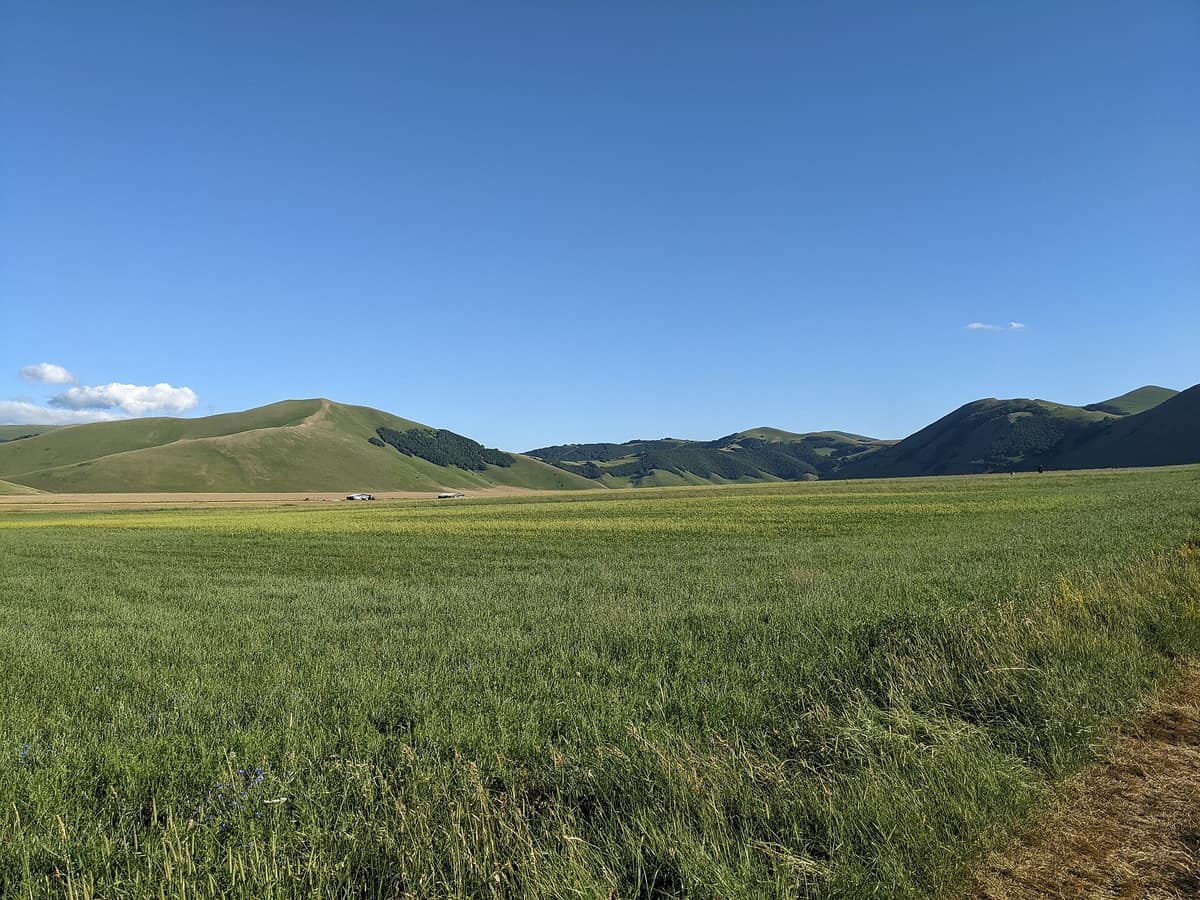
Monti Sibillini National Park
Parco Nazionale dei Monti Sibillini
Marche / Umbria (Visso / Norcia / Castelluccio di Norcia) · Italy
Photo: ValeJappo · CC BY-SA 4.0 · Wikimedia Commons
The legendary Apennine range of Monte Vettore (2.476 m), the Infernaccio Gorge, and the highland plateaus of Castelluccio.
The Sibillini are mountains steeped in legend. Popular lore recounts that the body of Pontius Pilate was cast into a lake beneath Monte Vettore; depending on water levels, it appears as one or two separate pools, earning it the nickname «lake with spectacles». Lago di Pilato is one of the exceedingly rare alpine-type glacial cirque tarns in the Apennines and the only natural lake in the Marche region. Across the Marche and Umbria, this national park protects the entire limestone massif across 16 municipalities distributed over two regions.
What makes it unique
A high-mountain glacial lake shelters an endemic red fairy shrimp that swims upside down, while surrounding plateaus erupt in a spectacular floral spectacle in late spring.
The place
Nature
The landscape
The park rises across a vast limestone massif. Its apex, Monte Vettore, reaches 2.476 m and forms the highest peak in the Marche, looming over Castelluccio. Two contrasting slopes drop from the main crest. The eastern flank is deeply dissected: valley floors plunge into narrow ravines, such as the Gole dell'Infernaccio shaped by tectonic faults and fluvial erosion, above which extensive beechwoods clad Apennine valleys. The western flank descends gently into Umbria across high structural basins: the celebrated Piani di Castelluccio. The Chienti and Tronto rivers define the natural boundaries to the north and south.
Lago di Pilato rests beneath the sheer cliffs of Vettore's peak. Its surface area and volume depend directly on rainfall and snowmelt, remaining frozen and snow-covered for much of the year. Depending on water levels, it divides into two communicating tarns, hence its nickname «lake with spectacles». It is the exclusive home of Chirocephalus marchesonii, an endemic, bright-red fairy shrimp measuring 9-12 mm that swims upside down.
The Piani di Castelluccio tell a cultural story: without centuries of pastoralism and agriculture, these uplands would be cloaked in beech forests. Today, traditional grazing and cultivation maintain flower-rich meadows. The plateau system—Piano Grande, Pian Piccolo, and Pian Perduto—is world-famous for its blossoming, where tiny white lentil flowers intermingle with wild mustard, poppies, cornflowers, and chamomile in a kaleidoscope of hues.
Wildlife and seasons
Late spring transforms the Piani di Castelluccio into a vast floral tapestry: poet's narcissus, wild peonies, mountain tulips, and yellow asphodels mingle with the blooming lentils. The timing, duration, and splendour of the bloom vary each year according to spring temperatures and snowpack, which can linger on the plateau well into May. High visitor numbers converge during peak bloom weekends, and park authorities advise weekday trips to avoid heavy traffic.
Among wildlife, red deer have inhabited the Sibillini since prehistoric times: fossil remains were discovered in 1978 in a cave on Monte Argentella. A papal bull of 1057 described the region as teeming with deer, which subsequently vanished as land was cleared for cultivation. The species appears depicted in medieval frescoes in Norcia, San Ginesio, and Ussita. The Apennine Pyrenean chamois was reintroduced in 2008, while the grey wolf roams throughout the interior, though sightings are elusive; its tracks are readily traceable in winter snow. Wandering male Marsican brown bear occasionally cross from Abruzzo National Park. Other mammals include roe deer, European wildcat, badger, red fox, brown hare, red squirrel, and crested porcupine.
Among birds, eight pairs of golden eagle nest on inaccessible limestone walls, surveyed during the 2025 monitoring census. The park also hosts peregrine falcon, common kestrel, common buzzard, little owl, European green woodpecker, tawny owl, long-eared owl, Eurasian eagle-owl, and rock partridge. Mountain streams hold freshwater river sculpin, sea trout, and South European roach. Amphibians include Savi's salamander, crested newt, and Italian newt; the Apennine yellow-bellied toad has not been recorded since 2013. Reptiles feature the common asp viper and the exceedingly rare Orsini's viper.
Species
With a page in the atlas
Being mentioned in a source doesn't guarantee sightings: check with the people who manage the area.
Memory and protection
History and conservation
The national park was established in 1993. In 2003 WWF Italy awarded the park the Golden Panda for successfully reintroducing dwarf mountain pine and silver fir. Park scientists continue long-term ecological monitoring of the wolf and its prey species.
Before you set off
Visiting
How to visit
The park has no fences, turnstiles, or entrance fees. Towns serve as natural gateways: Amandola accesses the eastern flank and the Ambro and Tenna valleys; Arquata del Tronto provides access to Monte Vettore; Norcia opens to the Piani di Castelluccio; and Visso leads into Valnerina and Monte Bove. Ten visitor centres and Park Houses operate thematic reception and educational facilities across ten settlements. The Deer Centre in Castelsantangelo sul Nera and the Chamois Visitor Centre in Fiastra maintain semi-wild enclosures allowing close observation, while Amandola's Anthropogeographic Museum explores the relationship between traditional human cultures and mountain ecosystems.
Hikers can choose among 17 official trails designed to showcase primary landscapes and habitats, along with historical shepherd paths linking villages to high summer pastures. Trail times account for panoramic stops: Fra Camosci ed Aquile is an easy tourist trail of 2.700 m (one hour one way); Le Vie della Fede covers 7.700 m counter-clockwise in 2 h 10 min (hiking grade); Nel Regno del Camoscio spans 14.400 m, requiring five hours and ten minutes from Frontignano (expert grade); and Al Cospetto della Regina extends 18.000 m taking 6 h 30 min (expert grade). The park also maintains eighteen nature trails, two of which are barrier-free for strollers and wheelchairs. For complete immersion, the Grande Anello dei Sibillini forms a 120 km circuit around the entire massif for hikers, equestrians, and mountain bikers, divided into nine day-stages for trekking.
Before you go
Traces of the 2016-2017 earthquakes remain visible and certain paths are damaged: the park uses a color-coded trail system to signal passable routes, and hikers should enquire locally before heading out. Summit ridges may be snowbound in winter and early spring, and certain gorges carry avalanche risks. To visit Castelluccio during peak bloom, choose weekdays.
Check access, rules and visiting conditions in the official information from the managing body before you set off.
Location
Where it is and how far it reaches
Boundary of Parco nazionale dei Monti Sibillini · IUCN II · © EEA, CDDA (CC-BY) The coordinate is estimated; it isn't a verified access point.
Transparency
Sources
The research data with its sources, and the official links for this place, are in the Spanish version of this page. See the Spanish version
Around it
The Parco Nazionale del Gran Sasso e Monti della Laga directly borders the park less than a kilometre away, sharing the same central Apennine backbone.
What else to explore nearby
Approximate straight-line distance between the edges of each area. It doesn't indicate access, routes or driving times.
- Gran Sasso and Monti della Laga National Park
Abruzzo / Lazio / Marche (L'Aquila / Teramo / Rieti)
Borders this area
The Italian 'Little Tibet' (Campo Imperatore) crowned by Corno Grande (2.912 m, the highest peak in the Apennines) and the Calderone glacier.
JFMAMJJASONDMay – October · Crowding moderate
If you like this place, elsewhere in Europe
Distant places with uncommon wildlife and habitats in common. The most widespread species don't count. Sharing species doesn't imply a corridor or guaranteed presence.
- Dinara Nature Park
Šibenik-Knin and Split-Dalmatia Counties (Knin / Sinj)
In common: Orsinis viper · European wildcat · Golden eagle — high mountain, karst and caves
The massif that gives its name to the entire Dinaric Alps and hosts Croatia’s highest peak (Dinara 1,831 m).
JFMAMJJASONDMay – October · Crowding very low
- Pelister National Park
Pelagonia (Bitola / Resen)
In common: Alectoris graeca · Eurasian eagle-owl · Golden eagle — high mountain
The oldest national park in North Macedonia (1948), established to preserve primeval Macedonian pine (molika) forests.
JFMAMJJASONDJune – October · Crowding very low
- Blidinje Nature Park - Čvrsnica Massif
West Herzegovina and Herzegovina-Neretva Cantons (Posušje / Jablanica)
In common: Orsinis viper · European wildcat · Brown bear — high mountain, karst and caves, lake
High karst mountains around the glacial Lake Blidinje featuring the iconic natural rock arch of Hajdučka Vrata.
JFMAMJJASONDJune – October · Crowding very low
Entry #529 of the original atlas.