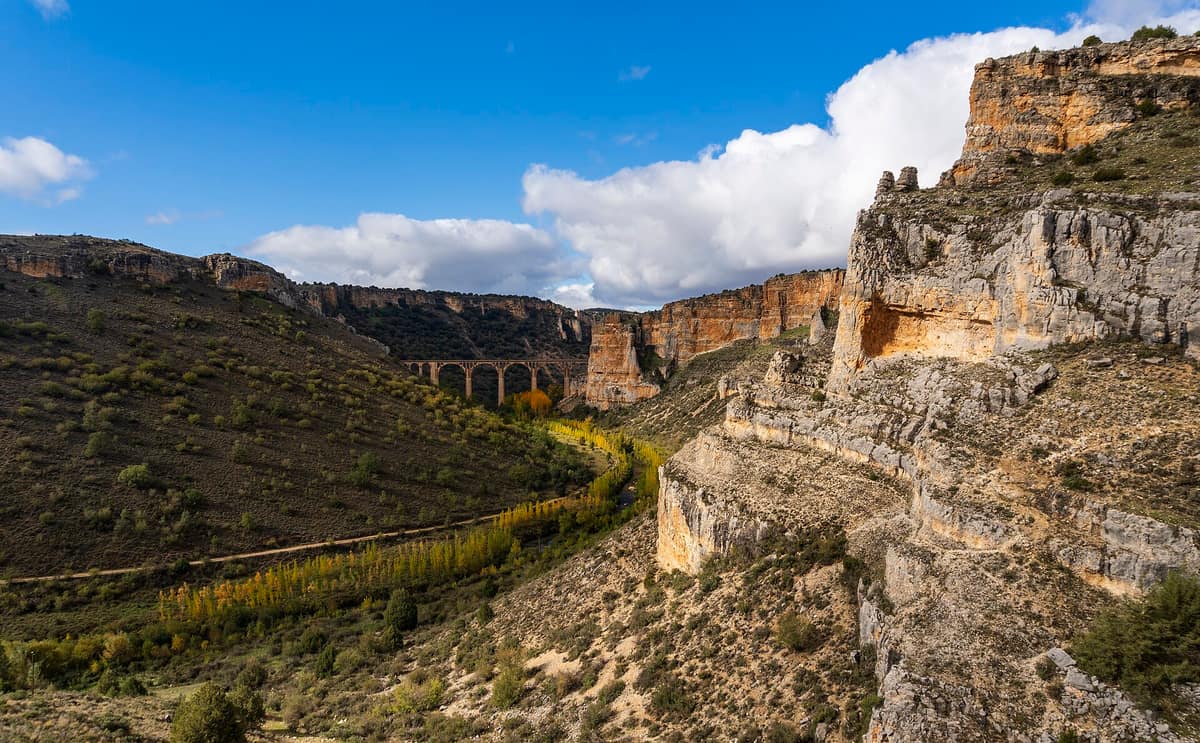
Hoces del Río Riaza Natural Park
Parque Natural Hoces del Río Riaza
Castile and León (Segovia / Maderuelo / Montejo de la Vega) · Spain
Photo: Pedro José Ponce Asensio · CC BY-SA 4.0 · Wikimedia Commons
Limestone gorge hosting the historic Montejo de la Vega Raptor Refuge founded by Félix Rodríguez de la Fuente in 1975.
A gentle river, a reservoir and, suddenly, a 150-metre rock wall with vultures wheeling overhead. That is Hoces del Río Riaza Natural Park, in north-eastern Segovia. It encompasses 6470 hectares spread between Montejo de la Vega de la Serrezuela, Valdevacas de Montejo and Maderuelo, and its renown comes from birds: the griffon vulture breeds here in one of Europe's largest colonies.
What makes it unique
More than 700 pairs of griffon vultures breed in these gorges, and at the Casa del Parque you can watch one of their nests live on camera.
The place
Nature
The landscape
The Riaza traverses the park from south-east to north-west, changing character three times along the way. First, between Maderuelo and the Linares del Arroyo dam, the topography is gentle and the river has been dammed since 1951. Next, between the dam and El Casuar stream, water cuts into the limestone for 5.5 kilometres, carving a canyon up to 150 metres deep and between 200 and 300 metres wide. Finally, beyond El Casuar, the river leaves the limestone behind and opens into an asymmetrical valley with a fertile floodplain, reaching Montejo de la Vega.
The canyon's creation can be read in the rock. The river sliced through Turonian limestone, reached Cenomanian marls and excavated its bed, aided by fault lines and karst processes. Along a stretch of 2.5 kilometres it twists repeatedly, etching four incised meanders of remarkably similar size and curvature. The sheer walls, stepped ledges and cavities provide ideal nesting sites for cliff-dwelling birds.
Above on the plateau, open steppe dominates, with pockets of Spanish juniper, holm oak and some gall oak adapted to a harsh continental climate. Spanish juniper rules, while holm oak above 900 metres on limestone soils rarely exceeds a stunted shrub form. Below along the valley floor, the river supports a riparian woodland of black poplars, willows, white poplars, alders and ashes.
Wildlife and seasons
Birds are the very essence of the park. Over 20 species listed under Annex 1 of the Birds Directive are catalogued here, prominently including the Egyptian vulture, crag martin, red-billed chough and Eurasian eagle-owl. The cliffs with the heaviest raptor concentrations are Cerro del Portillo, Peña de la Zorra and La Murcielaguera, which also shelters a major colony of mouse-eared bats.
The vulture year begins in winter. In November and December, courting pairs can be seen flying wingtip-to-wingtip. Starting in December they carry nesting sticks to cliff ledges, each pair laying just one single egg per year, meaning an entire season's effort rests on one fledgling. This is why park access is regulated throughout the breeding season.
Away from the cliffs, wildlife changes with the terrain. Across the moors abound red-necked nightjars, merlins, Dupont's larks and black-eared wheatears. Northern goshawks, tawny owls and golden eagles inhabit woodlands of holm oak, juniper and pine. At the river and the Linares del Arroyo reservoir, the province's prime waterbird wintering area, mallards, common pochards, great crested grebes and grey herons congregate. Mammals include the Eurasian otter, roe deer, badger, common genet, stone marten and wildcat.
Species
With a page in the atlas
Being mentioned in a source doesn't guarantee sightings: check with the people who manage the area.
Memory and protection
History and conservation
The area has been protected as a natural park since 18 January 2005. Human history is woven into the landscape: the hermitage of Casuar, a twelfth-century Romanesque church in the Riaza valley, has been a designated Cultural Heritage Site since 1997. Of the village of Linares del Arroyo, drowned by the reservoir, remains of a Romanesque church emerge depending on water levels; at the visitor centre, former residents recount the dam's construction in a documentary video. Outside the park, Maderuelo is a Historic-Artistic Ensemble and Heritage Site designated in 1993, with medieval town walls, towers and Romanesque churches.
Before you set off
Visiting
How to visit
Start at the Casa del Parque in Montejo de la Vega. The staff explain trails and nearby areas of interest, while the interpretive exhibits provide essential background before setting out: displays illustrate the canyon's geological formation and riparian, cliff and woodland wildlife, life-size replicas show griffon vultures, Egyptian vultures, golden eagles, eagle-owls and peregrine falcons, and a live web camera points directly into a vulture nest.
Then, explore on foot. The Senda entre Puentes is an easy 6 km circuit starting and finishing in Montejo de la Vega, feasible year-round; it passes the Peña Portillo cliffs for vulture viewing, as well as Spanish junipers and black pines. Another path leads from the visitor centre across a wooden footbridge over the Riaza towards the Las Torres cliffs. If you prefer walking among shepherd heritage and junipers, the circular Senda de las Tenadas de Valdevacas covers 4.5 km, taking 1 hour and 18 minutes with 100 metres of elevation change; the tenadas are traditional stone pens built by shepherds to shelter sheep.
The Senda del Río is the longest option: a linear 11.5 km moderate trail from Montejo de la Vega to the Linares del Arroyo dam. It threads the gorge between dense holm oaks and open juniper groves alongside the river's otter habitat, while an interpretive panel explains the canyon's formation before descending to the valley.
Before you go
The Senda del Río traverses the core nature reserve; between 1 January and 31 July prior authorization is required, with groups limited to a maximum of 10 people. Authorization is requested at the Casa del Parque in Montejo de la Vega, which also regulates other zones during bird breeding periods. Mobile reception is limited along the Senda de las Tenadas. Spring and autumn are the best seasons to visit, and the park is much quieter than the Duratón gorges.
Check access, rules and visiting conditions in the official information from the managing body before you set off.
Location
Where it is and how far it reaches
Boundary of Hoces del Río Riaza · IUCN II · © EEA, CDDA (CC-BY) The coordinate is estimated; it isn't a verified access point.
Transparency
Sources
The research data with its sources, and the official links for this place, are in the Spanish version of this page. See the Spanish version
Around it
About 26 km away lies Hoces del Río Duratón Natural Park, the region's other major limestone gorge, which is more frequented. Farther afield, Gorges de la Jonte shares with Riaza karst canyons, soaring vultures, the Egyptian vulture and the griffon vulture.
What else to explore nearby
Approximate straight-line distance between the edges of each area. It doesn't indicate access, routes or driving times.
- Hoces del Río Duratón Natural Park
Castile and León (Segovia / Sepúlveda / Sebastopol / San Frutos)
About 26 km away
Incised meanders 100 m deep carved into red limestone by the Duratón River, featuring the renowned cliffside hermitage of San Frutos.
JFMAMJJASONDApril – June · September – October · Crowding moderate
If you like this place, elsewhere in Europe
Distant places with uncommon wildlife and habitats in common. The most widespread species don't count. Sharing species doesn't imply a corridor or guaranteed presence.
- Montsant Natural Park
Catalonia (Province of Tarragona / Priorat comarca)
In common: Egyptian vulture · Griffon vulture · Eurasian otter — gorge and canyon, karst and caves
A range of limestone-conglomerate ramparts, gorges and Mediterranean forest inhabited by Bonelli's eagle and Iberian ibex.
JFMAMJJASONDMarch – June · September – November · Crowding low
- Els Ports Natural Park
Catalonia / Aragon / Valencian Community (Tarragona / Teruel / Castellón / Roquetes / Tortosa)
In common: Egyptian vulture · Griffon vulture · Eurasian otter — gorge and canyon, karst and caves
A rugged karst massif between Catalonia, Aragon, and the Valencian Community featuring limestone cliffs, southern beech groves, and the Iberian ibex.
JFMAMJJASONDApril – June · September – November · Crowding low
- Verdon Regional Natural Park - Grand Canyon
Alpes-de-Haute-Provence / Var (Castellane / Moustiers-Sainte-Marie)
In common: Egyptian vulture · Griffon vulture · Golden eagle — gorge and canyon, karst and caves, river corridor
The 'Grand Canyon of Europe', sheer limestone cliffs plunging 700 m carved out by the turquoise waters of the Verdon River.
JFMAMJJASONDApril – June · September – October · Crowding moderate
Entry #481 of the original atlas.