Hoces del Río Duratón Natural Park
Parque Natural Hoces del Río Duratón
Castile and León (Segovia / Sepúlveda / Sebastopol / San Frutos) · Spain
Photo: Carlos Delgado · CC BY-SA 3.0 · Wikimedia Commons
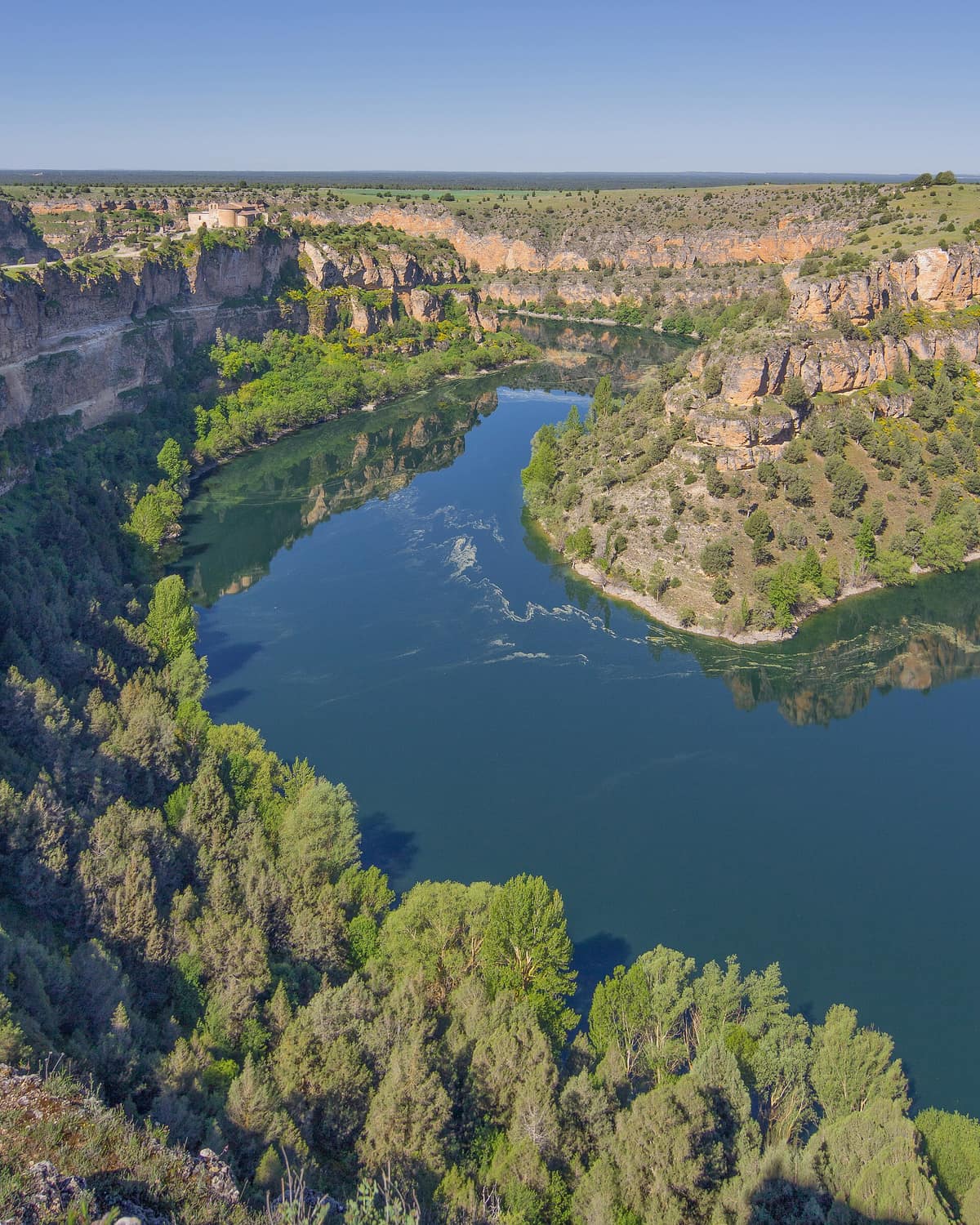
Incised meanders 100 m deep carved into red limestone by the Duratón River, featuring the renowned cliffside hermitage of San Frutos.
On the wall of a Segovian canyon nest almost 768 pairs of griffon vultures. There are so many that the spectacle lies not in seeking them, but simply in looking up. Hoces del Río Duratón Natural Park is located in north-eastern Segovia, downstream from the town of Sepúlveda, where the river has cut into a canyon with over 100 metres of vertical drop. Surrounding this nature lies rich history: the Romanesque hermitage of San Frutos, caves with Bronze Age engravings and the historic ensemble of Sepúlveda.
What makes it unique
A meander canyon where ochre rocks, riparian green and the flight of hundreds of vultures meet face to face.
The place
Nature
The landscape
The Duratón settled over a limestone surface and sliced through it, giving birth to the gorge. It follows a meandering course carved into hard Cretaceous limestone and dolomite, where cliff faces can exceed 100 m of vertical relief. Between Sepúlveda and the Burgomillodo reservoir, some 27 km of flat-bottomed gorges present a striking contrast: warm ochre cliffs alongside a lush green ribbon of riverside forest. Water never stops carving: erosion has shaped this canyon over millions of years and still continues. To the south-west, a different story unfolds: windblown sands forming dunes aligned with prevailing north-westerly winds.
Four distinct environments organise the park. The plateau above features open juniper and savin woodlands, degraded by human activity and largely replaced by thyme and gorse pseudo-steppes; it is a realm of harsh extremes, with bitter cold and fierce winds in winter, intense summer heat and prolonged drought. Over the south-western sands grow reforested maritime pine woods. Original rupicolous flora thrives along the crags: stonecrops, navelworts and Iberian endemics such as Biscutella valentina, Dianthus pungens and Campanula hispanica. Along the valley floor linger remnants of gallery forest with willows, ashes, poplars, elms and alders.
Wildlife and seasons
Look to the cliffs. Alongside the griffon vulture, the park's most iconic bird, there are nesting Egyptian vultures, peregrine falcons, common kestrels, golden eagles and Eurasian eagle-owls, as well as colonies of western jackdaws and red-billed choughs. Forest raptors include booted eagles, northern goshawks, common buzzards, black and red kites and Eurasian hobbys. The high plateau supports a passerine community highlighted by Dupont's lark.
On the ground, roe deer, wild boars and red foxes roam the pine woods, alongside European badgers, stone martens, least weasels, European hares and European rabbits; occasional isolated sightings of the Eurasian otter also occur. Reptiles include the ocellated lizard, large psammodromus and Montpellier, ladder and viperine snakes.
Species
With a page in the atlas
Being mentioned in a source doesn't guarantee sightings: check with the people who manage the area.
Memory and protection
History and conservation
Goatherds, stonecutters, farmers and resin workers historically made their living from the Duratón, shaping the cultural landscape protected today. Caves with Bronze Age engravings, the San Frutos hermitage and the historic town of Sepúlveda complete the park's heritage.
Before you set off
Visiting
How to visit
Start at the Casa del Parque in Sepúlveda, housed in the ancient church of Santiago. Its reception provides maps, route guidance and permit management, while the exhibition offers an imaginary journey through the canyon: displays recreating the fertile valley, cliffs and plateau, a replica of the Cave of the Seven Altars with Visigothic carvings, and a section dedicated to traditional trades of goatherds, quarrymen, farmers and resin tappers. The centre also organizes nest-box volunteer programs and guided tours.
The Senda de los Dos Ríos is a five-kilometre circuit starting and ending at the visitor centre, designed for birdwatching and mammal track identification. The Senda de la Molinilla, an easy trail, covers 3.7 kilometres one-way in about forty-five minutes. The simplest walk into the gorges begins at the car park where the Villaseca track ends and leads out along the rocky spur to the hermitage of San Frutos. The path to the hermitage is linear, measuring nine hundred and twenty-five metres each way and taking one hour in total. Along the path, a stone bridge spans a cleft known as La Cuchillada and leads to the ancient Benedictine priory, featuring anthropomorphic early medieval tombs in its cemetery.
Before you go
Plan your visit starting from the Casa del Parque, which manages permits and distributes maps and route guides.
Check access, rules and visiting conditions in the official information from the managing body before you set off.
Location
Where it is and how far it reaches
Boundary of Hoces del Río Duratón · IUCN II · © EEA, CDDA (CC-BY) The coordinate is estimated; it isn't a verified access point.
Transparency
Sources
The research data with its sources, and the official links for this place, are in the Spanish version of this page. See the Spanish version
Around it
Hoces del Río Riaza Natural Park lies about twenty-six kilometres away and Sierra de Guadarrama and Montes de Valsaín National Park about twenty-seven. Farther afield, Bardenas Reales Natural Park shares the Egyptian vulture, eagle-owl and griffon vulture across canyons and karst, as does Serra de Montsant Natural Park with eagle-owls, griffon vultures and peregrine falcons, and Priroden Park Rusenski Lom with Egyptian vultures and eagle-owls.
What else to explore nearby
Approximate straight-line distance between the edges of each area. It doesn't indicate access, routes or driving times.
- Hoces del Río Riaza Natural Park
Castile and León (Segovia / Maderuelo / Montejo de la Vega)
About 26 km away
Limestone gorge hosting the historic Montejo de la Vega Raptor Refuge founded by Félix Rodríguez de la Fuente in 1975.
JFMAMJJASONDApril – June · September – October · Crowding very low
- Sierra de Guadarrama National Park and Montes de Valsaín
Community of Madrid / Castilla y León (Segovia / Cercedilla / Manzanares el Real / Valsaín)
About 27 km away
The granitic high mountain crowning the Central System (Peñalara 2,428 m), La Pedriza, and the historic Pine Forest of Valsaín.
JFMAMJJASONDMay – October · Crowding moderate
If you like this place, elsewhere in Europe
Distant places with uncommon wildlife and habitats in common. The most widespread species don't count. Sharing species doesn't imply a corridor or guaranteed presence.
- Verdon Regional Natural Park - Grand Canyon
Alpes-de-Haute-Provence / Var (Castellane / Moustiers-Sainte-Marie)
In common: Egyptian vulture · Griffon vulture · Eurasian eagle-owl — gorge and canyon, karst and caves, river corridor
The 'Grand Canyon of Europe', sheer limestone cliffs plunging 700 m carved out by the turquoise waters of the Verdon River.
JFMAMJJASONDApril – June · September – October · Crowding moderate
- Montsant Natural Park
Catalonia (Province of Tarragona / Priorat comarca)
In common: Egyptian vulture · Griffon vulture · Eurasian eagle-owl — gorge and canyon, karst and caves
A range of limestone-conglomerate ramparts, gorges and Mediterranean forest inhabited by Bonelli's eagle and Iberian ibex.
JFMAMJJASONDMarch – June · September – November · Crowding low
- Els Ports Natural Park
Catalonia / Aragon / Valencian Community (Tarragona / Teruel / Castellón / Roquetes / Tortosa)
In common: Egyptian vulture · Griffon vulture · Eurasian eagle-owl — gorge and canyon, karst and caves
A rugged karst massif between Catalonia, Aragon, and the Valencian Community featuring limestone cliffs, southern beech groves, and the Iberian ibex.
JFMAMJJASONDApril – June · September – November · Crowding low
- Cijevna River Canyon
Tuzi Municipality / Podgorica
In common: Egyptian vulture · Eurasian eagle-owl · Peregrine falcon — gorge and canyon, karst and caves
Narrow miniature canyon carved into pure limestone on the way to Lake Skadar.
JFMAMJJASONDApril – June · September – October · Crowding low
Entry #480 of the original atlas.