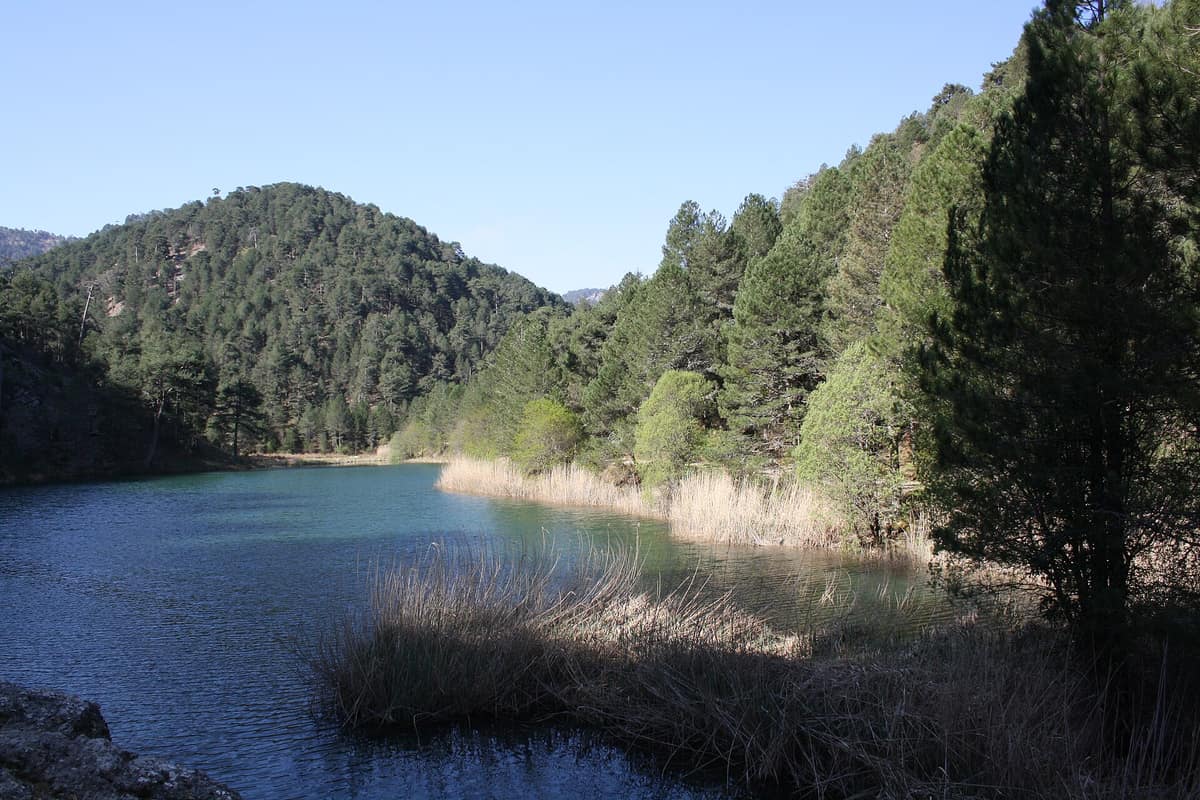
Sierras de Cazorla, Segura y Las Villas Natural Park
Parque Natural Sierras de Cazorla, Segura y Las Villas
Andalusia (Jaén — Cazorla / Segura de la Sierra / Villacarrillo) · Spain
Photo: FrDr · CC BY-SA 4.0 · Wikimedia Commons
Spain's largest protected area: black pine forests, headwaters of the Guadalquivir and the reintroduction of the bearded vulture in Andalusia.
It begins as a trickle of water inside a flooded cavern and ends as one of Spain's greatest rivers. In the Sierras de Cazorla, Segura y Las Villas rise both the Guadalquivir and the Segura: these mountains form the watershed between the Atlantic and the Mediterranean. Covering 214,336 hectares, the park is the largest protected area in Spain and the second largest in Europe, harbouring the country's most extensive continuous pine forest and peaks exceeding 2,000 metres.
What makes it unique
Out of over 1,300 plant species, 24 grow only here, such as the Cazorla violet, and among them is even a carnivorous butterwort.
The place
Nature
The landscape
The relief is rugged and mid-mountain: towering rock ramparts rising between deep valleys and forests of European black pine. At the highest point, Cerro las Empanadas reaches 2107 metres, and the park descends to around 500 metres along the Guadiana Menor River. Between these two elevations lies almost everything: El Yelmo, one of the most popular peaks for paragliding, the Hernán Pelea plateau, Spain's largest high plateau, with over 5,000 hectares at roughly 1,600 metres, and the bare limestone plateaus surrounding it, such as Calar de las Palomas.
Then comes the water, which explains all the rest. The Segura springs from a natural flooded cave at Fuente Segura at an elevation of 1413 metres. Along its course, water dissolves limestone and dolomite, creating karst landmarks: Cerrada de Elías and Salto de los Órganos on the Borosa; La Toba, a travertine shelf with aquatic caves beside the Segura; and the Anguijones caves by the Anchuricas reservoir. Waterfalls complete the scenery, and La Osera, at 132 metres, is the highest in Andalusia.
The forest climbs in altitudinal zones. Up to 900 metres Aleppo pine grows with strawberry trees and mastic. Higher up stand holm oaks, Portuguese oaks and maritime pines. In the dampest valleys grow ancient yews and hollies, extremely rare in Andalusia, while ash, willow and poplar line the rivers alongside rushes and bulrushes sheltering waterbirds. Among all the conifers, the European black pine reigns supreme: the oldest in Spain, some over a thousand years old, grow in Puertollano. Along the Sendero de los Tejos Milenarios stands Europe's most ancient yew, roughly 2,000 years old.
Wildlife and seasons
High above the crags you can see the flight of golden eagles and griffon vultures. The bearded vulture and Egyptian vulture are being reintroduced, and the park preserves species that live nowhere else, such as the Cazorla violet and Valverde's lizard. The Spanish ibex is the emblematic mammal. Its numbers reached 11,000 animals in 1988, but a scabies epidemic severely reduced the herd. Red deer, wild boars, red foxes, fallow deer and mouflons are also widespread.
Not all historical wildlife survived. Wolves, brown bears, roe deer, lynx and cinereous vultures vanished from the park, primarily due to past hunting and poison baits. The native white-clawed crayfish has been driven nearly extinct by a water mould introduced with the American signal crayfish.
Species
With a page in the atlas
Being mentioned in a source doesn't guarantee sightings: check with the people who manage the area.
Memory and protection
History and conservation
These pine woods have a naval heritage. From 1748, when the Sierra de Segura was designated a maritime province, its timber was harvested to build ships for the navy, and the forests were partially reforested. The park has been a biosphere reserve since 1983, a natural park since 1986 and an SPA since 1988.
Forest fires are the primary threat to local flora and fauna, occurring with increasing frequency: in the summer of 2005, following an electrical storm, over 5,000 hectares burned across Sierra de las Villas and El Tranco.
Before you set off
Visiting
How to visit
The gateway to the park is the Torre del Vinagre visitor centre, at kilometre point 45 of the A-319 between Cazorla and Hornos de Segura. Its exhibition showcases five distinct environments: rock, water, pine forest, high summits and human landscapes, highlighting the bearded vulture and Egyptian vulture. Beside it lie grounds with a historic forestry house and specimens such as giant sequoias, as well as the Torre del Vinagre botanical garden, which displays the park's most unique botanical treasures with informative labels.
Water offers abundant activities: a boat trip across the Tranco reservoir, walking beside the Borosa River, visiting the sources of the Guadalquivir and Segura or admiring the Chorro Gil waterfall. The full hike to the source of the Borosa is rated difficult, so it is not a casual stroll.
Before you go
The complete trail to the source of the Borosa is rated difficult. The Torre del Vinagre centre provides maps, nature activities and environmental education to help you plan your outing.
Check access, rules and visiting conditions in the official information from the managing body before you set off.
Location
Where it is and how far it reaches
Boundary of Sierras de Cazorla, Segura y las Villas · © EEA, CDDA (CC-BY) The coordinate is estimated; it isn't a verified access point.
Transparency
Sources
The research data with its sources, and the official links for this place, are in the Spanish version of this page. See the Spanish version
Around it
Farther away lie other mountain ranges sharing Spanish ibex and griffon vultures: Sierra de las Nieves National Park, Els Ports Natural Park and Peneda-Gerês National Park, the latter featuring golden eagles and ibex in a karst mountain terrain. The Lefka Ori Massif shares bearded vultures, golden eagles, karst and canyons with Cazorla.
If you like this place, elsewhere in Europe
Distant places with uncommon wildlife and habitats in common. The most widespread species don't count. Sharing species doesn't imply a corridor or guaranteed presence.
- Els Ports Natural Park
Catalonia / Aragon / Valencian Community (Tarragona / Teruel / Castellón / Roquetes / Tortosa)
In common: Spanish ibex · Bearded vulture · Griffon vulture — old-growth forest, karst and caves, gorge and canyon
A rugged karst massif between Catalonia, Aragon, and the Valencian Community featuring limestone cliffs, southern beech groves, and the Iberian ibex.
JFMAMJJASONDApril – June · September – November · Crowding low
- Abruzzo, Lazio and Molise National Park
Abruzzo, Lazio and Molise regions (L'Aquila, Frosinone and Isernia provinces)
In common: European black pine · Bearded vulture · Griffon vulture — karst and caves
Sanctuary of the Marsican brown bear and Apennine wolf in primeval beechwoods and high alpine valleys of central Italy.
JFMAMJJASONDMay – June · October · Crowding moderate
- Hoces del Río Riaza Natural Park
Castile and León (Segovia / Maderuelo / Montejo de la Vega)
In common: European black pine · Griffon vulture · Golden eagle — karst and caves, river corridor, gorge and canyon
Limestone gorge hosting the historic Montejo de la Vega Raptor Refuge founded by Félix Rodríguez de la Fuente in 1975.
JFMAMJJASONDApril – June · September – October · Crowding very low
- Pyrénées National Park
Occitanie / Nouvelle-Aquitaine (Hautes-Pyrénées / Pyrénées-Atlantiques)
In common: Spanish ibex · Bearded vulture · Golden eagle — old-growth forest, gorge and canyon
The French slope of the central Pyrenees, twin to Ordesa: glacial cirques, bearded vultures, isards, and Pyrenean desmans.
JFMAMJJASONDJune – September · Crowding moderate
Entry #1041 of the original atlas.