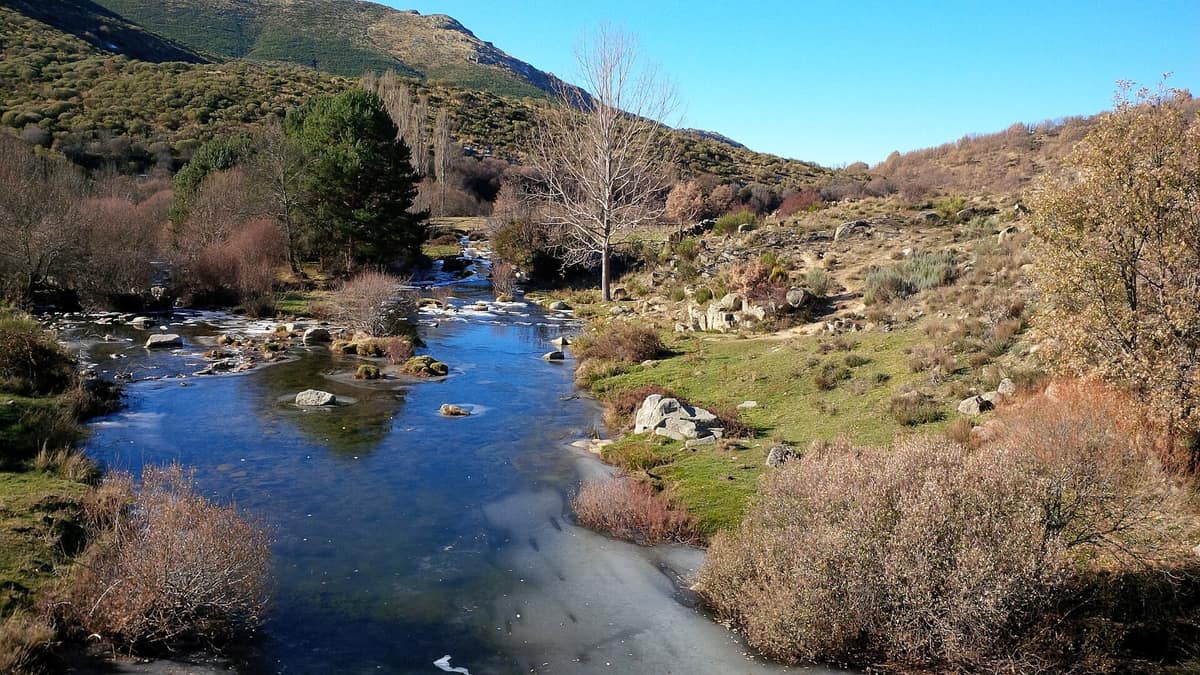
Sierra de Gredos Regional Park
Parque Regional de la Sierra de Gredos
Castile and León (Ávila / Hoyos del Espino / El Hornillo / Candeleda) · Spain
Photo: Lolalatorre · CC BY-SA 4.0 · Wikimedia Commons
The granite spine of the Central System (Almanzor 2,592 m) featuring glacial cirques, Laguna Grande and the Gredos ibex.
A colossal granite rampart that separates two river basins and filled with ice during glacial epochs. That is the Sierra de Gredos, at the southern tip of Ávila province: 86,236 hectares of sharp peaks, glacial tarns, cirques and gorges, crowned by Pico Almanzor at 2,592 metres, the highest point of the entire Central System. It is also the paramount stronghold of the Spanish ibex.
What makes it unique
Three local endemics inhabit its high summits, the Spanish ibex, Almanzor salamander and Ávila snow vole, in a massif preserving one of southern Europe's finest glacial landscapes.
The place
Nature
The landscape
Gredos rose during the Alpine Orogeny between 15 and 30 million years ago, when the Central System was uplifted and fractured into massive fault blocks. Then came the Quaternary. Torrential streams cut deep into the southern slopes while glaciers sculpted the north, leaving 41 mountain glaciers comprising valley, cirque and slope formations. Today you can admire glacial lakes, amphitheatre cirques, canyons and morainic deposits. Freeze-thaw gelifraction carved sharp spires and knife-edge crests, renowned for their rugged beauty.
This great elevation is mirrored in altitudinal vegetation zones, representing 4 of the 5 bioclimatic zones of the Mediterranean region. On the northern face, summit dwarf scrub and broom heath predominate, with Scots pine only forming extensive stands around Navarredonda de Gredos and Hoyos del Espino. Conversely, the southern face abounds in maritime pine, interspersed with agricultural terraces of cherry trees, sweet chestnuts, fig trees and olive groves. Above 2,000 metres vegetation dwindles to dense dwarf broom and creeping juniper, and on the highest cirque crags the sole plant cover consists of saxicolous lichens.
The greatest botanical values dwell in the rocks: Gredos chamomile, Gredos ironwort and wild mignonette grow wedged into granite crevices. In the lower reaches of southern gorges small stands of Portugal laurel persist.
Wildlife and seasons
Gredos is home to more than 230 catalogued vertebrate species. On the high summits, the Spanish ibex commands the cirque ridges, while the Almanzor salamander and Ávila snow vole complete the trio of local endemics. Among birds there are two endangered species, the Spanish imperial eagle and black stork, along with vulnerable raptors such as the Egyptian vulture and cinereous vulture. The golden eagle, griffon vulture, alpine accentor and common rock thrush are also present. Mammals include the Pyrenean desman, Iberian shrew, Eurasian otter and European wildcat.
Species
With a page in the atlas
Being mentioned in a source doesn't guarantee sightings: check with the people who manage the area.
Memory and protection
History and conservation
Many trails in Gredos originated as pastoral routes. The Vereda del Puerto de Candeleda is a historic transhumance droveway along which herds ascended to cool summer pastures on the northern face, while the Senda del Puerto del Peón is an ancient drover trail retaining stretches of original stone paving. El Risquillo preserves tools from traditional trades, including pine resin harvesting. Foremost among historical landmarks is the Roman road climbing Puerto del Pico.
Before you set off
Visiting
How to visit
The Casa del Parque Pinos Cimeros in Hoyos del Espino is the finest trailhead for the northern slopes. There staff help plan excursions, an audiovisual presentation recounts the massif's geology, and a summit-mounted remote camera with 360° pan and zoom lets you scan the crags for ibex and raptors. On the southern slopes, El Risquillo offers an olfactory bank of mountain herbs, lighting displays explaining high-altitude species and a raptor identification game. Next to it, an accessible boardwalk leads through a maritime pine wood.
The most classic hike sets out from the Plataforma car park at the end of the road from Hoyos del Espino, ascending a granite-flagged path to the Circo de Gredos. The Senda de la Laguna Grande, spanning 6.40 km and roughly two and a half hours, climbs up to Los Barrerones before descending to the lake; it is graded medium-high difficulty. From the pass, the cirque and tarn suddenly emerge, the cold transparent waters mirroring Risco de la Ventana, Los Tres Hermanitos, Cuchillar de las Navajas and El Sagrao. Along the path you may spot Spanish ibex, Gredos common toad and Almanzor salamander.
For forest walks, the Senda del Pinar de Navarredonda covers three kilometres at easy difficulty through a mature Scots pine wood with trees over a century old, designed for birdwatching: great spotted woodpeckers, Eurasian jays, Eurasian nuthatches and coal tits. Two panels and several benches invite quiet nature observation.
Before you go
The Senda de la Rubía starts at Puerto del Pico at 1,395 m, and the Laguna Grande hike is graded medium-high difficulty.
Check access, rules and visiting conditions in the official information from the managing body before you set off.
Location
Where it is and how far it reaches
Boundary of Sierra de Gredos · IUCN V · © EEA, CDDA (CC-BY) The coordinate is estimated; it isn't a verified access point.
Transparency
Sources
The research data with its sources, and the official links for this place, are in the Spanish version of this page. See the Spanish version
Around it
Farther away, other mountain massifs share Spanish ibex and golden eagles in alpine scenery: Sierra Nevada National and Natural Park, with high alpine peaks and glacial relict tarns, Els Ports Natural Park and Peneda-Gerês National Park. Pieniny National Park - Dunajec Gorge, by contrast, shares Scots pine and mature woodlands with Gredos.
If you like this place, elsewhere in Europe
Distant places with uncommon wildlife and habitats in common. The most widespread species don't count. Sharing species doesn't imply a corridor or guaranteed presence.
- Sierra Nevada National and Natural Park
Andalusia (Granada / Almería / Capileira / Trevélez / Monachil)
In common: Spanish ibex · Golden eagle — high mountain, glacial landscape, old-growth forest
The roof of the Iberian Peninsula (Mulhacén 3,479 m and Veleta 3,396 m), a Biosphere Reserve with over 80 exclusive endemic plant species.
JFMAMJJASONDMay – October · Crowding moderate
- Pyrénées National Park
Occitanie / Nouvelle-Aquitaine (Hautes-Pyrénées / Pyrénées-Atlantiques)
In common: Spanish ibex · Golden eagle — high mountain, glacial landscape, old-growth forest
The French slope of the central Pyrenees, twin to Ordesa: glacial cirques, bearded vultures, isards, and Pyrenean desmans.
JFMAMJJASONDJune – September · Crowding moderate
- Sierra de Guadarrama National Park and Montes de Valsaín
Community of Madrid / Castilla y León (Segovia / Cercedilla / Manzanares el Real / Valsaín)
In common: Spanish ibex — high mountain, glacial landscape, old-growth forest
The granitic high mountain crowning the Central System (Peñalara 2,428 m), La Pedriza, and the historic Pine Forest of Valsaín.
JFMAMJJASONDMay – October · Crowding moderate
- Gerês-Xurés Transboundary Biosphere Reserve
Northern Portugal (Viana do Castelo / Braga / Vila Real) (PT) / Galicia (Ourense / Lobios) (ES)
In common: Spanish ibex · Golden eagle — high mountain, old-growth forest
Portugal's sole National Park joined with Galicia's Serra do Xurés Natural Park, forming a transboundary reserve of granite monoliths and herds of free-roaming Garrano horses.
JFMAMJJASONDMay – October · Crowding low
Entry #482 of the original atlas.