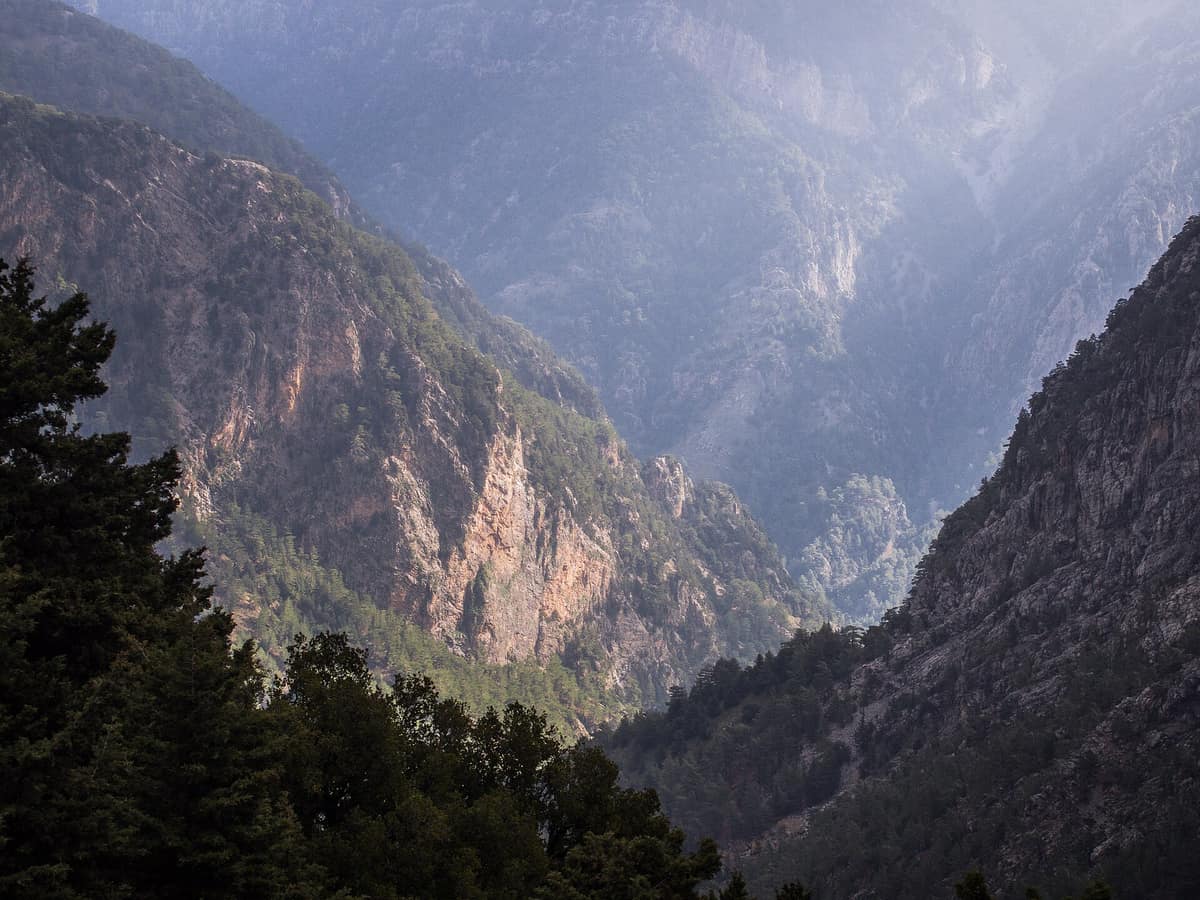
Samaria Gorge National Park - Crete
Samaria National Park
Crete Island (Chania / White Mountains - Lefka Ori) · Greece
Photo: C messier · CC BY-SA 4.0 · Wikimedia Commons
The queen of Mediterranean gorges (16 km of sheer precipices), exclusive sanctuary of the Cretan wild goat (Kri-Kri).
You enter from above, at Xyloskalo at 1227 m, and descend for hours following the gradient until the trail ends at the sea. That is the Samaria Gorge: a colossal chasm carved by a mountain river between the White Mountains and Mount Volakias, in southwestern Crete, traversed from end to end from the high mountains to the coastal village of Agia Roumeli. Most of the path is stony, crossing the riverbed multiple times via wooden footbridges or stepping stones.
What makes it unique
A gorge hiked from alpine heights down to the sea, with the Cretan wild goat as its living emblem.
The place
Nature
The landscape
The White Mountains, the massive limestone range cradling the gorge, take their name from the pale color of their summits, rock-white in summer and autumn and snow-white in winter. Pachnes, at 2.453 m, is the highest peak, and more than 30 summits surpass 2.000 m. Above 1.800 m, the central and southern parts of the massif resemble a barren lunar plateau. Subterranean exploration has revealed Greece's only two caves deeper than a kilometer: Gourgouthakas and the Lion Cave.
The main section of the gorge measures 13 km, followed by another three kilometers from the park exit to Agia Roumeli: around 16 km in total. The most famous constriction is the Portes (Gates), 1,5 km from the Agia Roumeli entrance, where the gorge narrows to just four meters wide beneath sheer rock walls soaring nearly 300 meters.
The park monitors fifteen habitat types, including temporary Mediterranean ponds and intermittent streams, as well as native stands of Mediterranean cypress and oriental plane. In total, thirty-four protected plant species are tracked, including Alyssum fragillimum, Anthemis samariensis, and Bupleurum kakiskalae.
Wildlife and seasons
The park's flagship species is the agrimi, the Cretan wild goat and largest native mammal on Crete. It favors steep mountain crags, ranging from arid alpine ridges to shrubby cliffs near conifer forests. Today it survives in the wild only within the White Mountains, alongside protected island backup populations on Agioi Theodoroi, Moni, Sapientza, Agioi Pantes, and Atalandonisi.
The hardest creatures to see are the most extraordinary. The Cretan wildcat was thought extinct until 1996, when researchers from the University of Perugia trapped a live specimen. The Cretan white-toothed shrew is the island's only endemic mammal, elusive and rarely studied. The bearded vulture, which drops heavy bones from high in the sky onto rocks to shatter them before spiraling down, now persists in Greece only on Crete: the White Mountains harbor two of the country's three breeding pairs. Far easier to spot is the griffon vulture, soaring in slow, wide circles on rising thermal currents. In total, thirty-two mammal, three amphibian, eleven reptile, and around two hundred bird species have been recorded in the White Mountains.
Even a protected trapdoor spider, Macrothele cretica, is endemic to the region.
Species
With a page in the atlas
Being mentioned in a source doesn't guarantee sightings: check with the people who manage the area.
Memory and protection
History and conservation
The gorge was designated a national park in 1962, primarily to safeguard the rare kri-kri wild goat, which survives almost exclusively here and on offshore islet sanctuaries. The village of Samariá, nestled deep within the canyon, was evacuated by its final inhabitants in 1962 to clear space for the park; both village and canyon derive their name from the historic Byzantine church of Óssia María.
The White Mountains also served as a fortified sanctuary for Cretan rebels during uprisings against Venetian rule, Ottoman occupation, and later during the German resistance in World War II.
Before you set off
Visiting
How to visit
The gorge is hiked in a single direction from end to end: around 800 people make the journey daily, with an average walk lasting six to seven hours, breaks included. The classic route runs from Xyloskalo down to Agia Roumeli. Xyloskalo is accessible by car or bus, but the southern exit at Agia Roumeli is connected only by sea. Before starting your descent, visit the Omalos information center: it details both the natural and cultural heritage of the protected reserve.
Hikers must stay strictly on the main trail; leaving it requires a special research permit. Rangers request that you heed their instructions and warning signs, particularly regarding rockfall, without straying off-trail for any reason. Walk deliberately, rest frequently, and look around. The park recommends spending the night in Agia Roumeli rather than rushing a day trip.
The open season runs from 1 May to 15 October, between six in the morning and four in the afternoon. Fair weather may extend operations until 31 October, though the gorge may close early if flash storms damage the pathway.
From Agia Roumeli, ferries depart for Sfakia, Sougia, or Paleochora, connecting with public buses returning to Chania.
Before you go
Camping and overnight stays inside the park, swimming in rivers and pools, and lighting open fires outside designated rest spots are strictly forbidden. There are no shops inside the canyon, so carry sufficient food; freshwater springs and toilet facilities are available at regular intervals.
Before making travel arrangements, check the official ticketing website to confirm the gorge is open: it can be closed from either entrance on short notice.
Check access, rules and visiting conditions in the official information from the managing body before you set off.
Location
Where it is and how far it reaches
Boundary of Samaria · IUCN II · © EEA, CDDA (CC-BY) The coordinate is estimated; it isn't a verified access point.
Transparency
Sources
The research data with its sources, and the official links for this place, are in the Spanish version of this page. See the Spanish version
Around it
The gorge is nestled directly within the Lefka Ori Massif, the very White Mountains that envelop it. Far from Crete, Munzur Valley National Park in eastern Turkey shares wild goats, deep canyons, and rugged alpine terrain.
If you like this place, elsewhere in Europe
Distant places with uncommon wildlife and habitats in common. The most widespread species don't count. Sharing species doesn't imply a corridor or guaranteed presence.
- Els Ports Natural Park
Catalonia / Aragon / Valencian Community (Tarragona / Teruel / Castellón / Roquetes / Tortosa)
In common: Bearded vulture · Griffon vulture · Golden eagle — gorge and canyon, karst and caves, high mountain
A rugged karst massif between Catalonia, Aragon, and the Valencian Community featuring limestone cliffs, southern beech groves, and the Iberian ibex.
JFMAMJJASONDApril – June · September – November · Crowding low
- Verdon Regional Natural Park - Grand Canyon
Alpes-de-Haute-Provence / Var (Castellane / Moustiers-Sainte-Marie)
In common: Bearded vulture · Griffon vulture · Golden eagle — gorge and canyon, karst and caves
The 'Grand Canyon of Europe', sheer limestone cliffs plunging 700 m carved out by the turquoise waters of the Verdon River.
JFMAMJJASONDApril – June · September – October · Crowding moderate
- Sierras de Cazorla, Segura y Las Villas Natural Park
Andalusia (Jaén — Cazorla / Segura de la Sierra / Villacarrillo)
In common: Bearded vulture · Griffon vulture · Golden eagle — gorge and canyon, karst and caves
Spain's largest protected area: black pine forests, headwaters of the Guadalquivir and the reintroduction of the bearded vulture in Andalusia.
JFMAMJJASONDApril – June · September – November · Crowding low
- Abruzzo, Lazio and Molise National Park
Abruzzo, Lazio and Molise regions (L'Aquila, Frosinone and Isernia provinces)
In common: Bearded vulture · Griffon vulture — karst and caves, high mountain
Sanctuary of the Marsican brown bear and Apennine wolf in primeval beechwoods and high alpine valleys of central Italy.
JFMAMJJASONDMay – June · October · Crowding moderate
Entry #400 of the original atlas.