Adamello-Brenta Natural Park
Parco Naturale Adamello-Brenta
Trentino (Pinzolo / Madonna di Campiglio / Tovel) · Italy
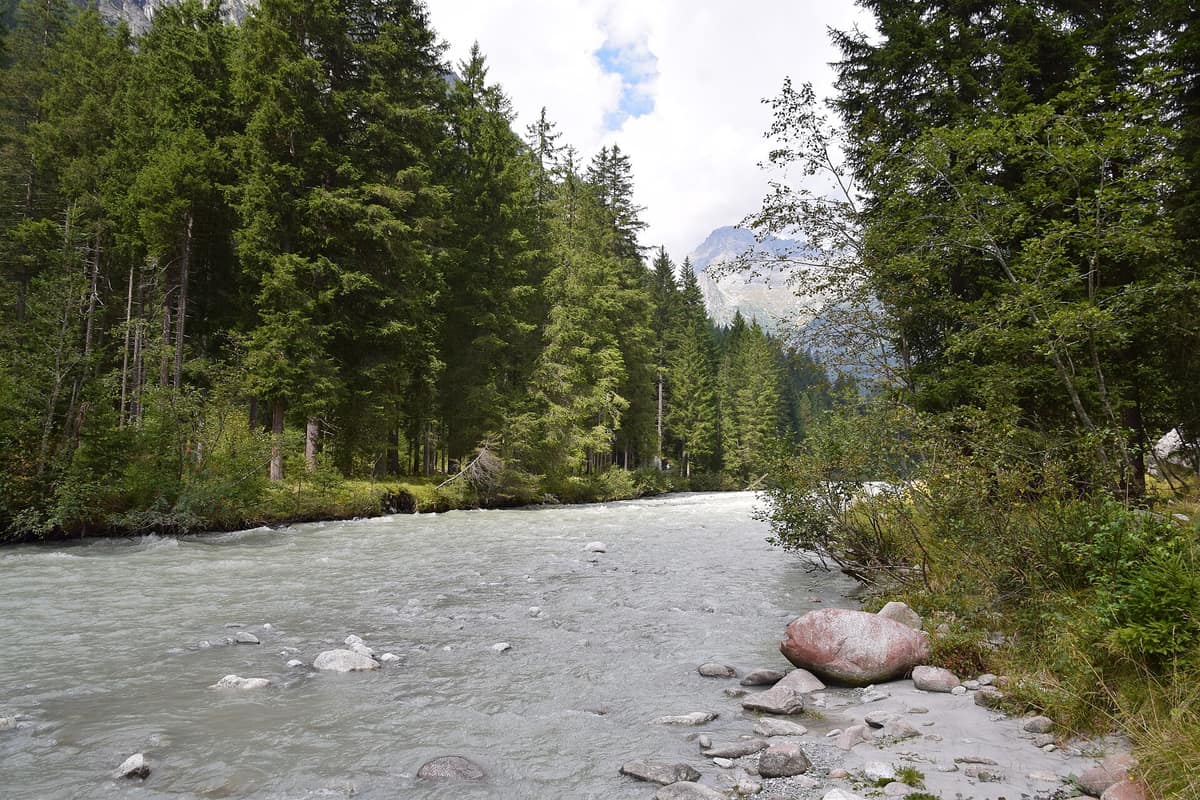
Photo: Elena749 · CC BY-SA 4.0 · Wikimedia Commons
Two opposing geological worlds facing each other: the limestone spires of the Brenta Dolomites and the glaciated granite massif of the Adamello (home to Trentino's historic brown bear).
Two entirely contrasting mountain realms face each other across a deep valley. On one side, the Brenta Group, with its «stone fortresses» of spires, pinnacles, and sheer precipices forged from ancient seabed sediments. On the other, the Adamello-Presanella massif, composed of tonalite, an extremely dense magmatic rock born deep within the Earth's crust. Between them flows the Val Rendena, and together they form the Adamello-Brenta Natural Park in Trentino: 625,83 km² of rugged mountain terrain ranging from 477 to 3.558 metres in altitude.
What makes it unique
Two opposing geological realms coexist within a single park, inhabited by the brown bear, the park's symbolic animal that once stood on the brink of extinction.
The place
Nature
The landscape
The environment typifies the south-central Alpine arc: coniferous forests blanket slopes up to 1.800 metres, giving way above to alpine meadows and rock-face flora reaching beyond 2.500 metres. Forests cover one third of the park, while pastures, glacial torrents, peat bogs, and inaccessible cliffs occur across all elevations.
Geology provides the central storyline. The Triassic witnessed the birth of the Dolomites in tropical Pangea, among coral atolls and tidal flats where the Main Dolomite was deposited. Those ancient tropical sediments now form spires that scrape the sky. Opposite them, the Adamello-Presanella is a massive tonalite intrusion. Both massifs have been sculpted by water and ice for some 20 million years, since the Southern Alps first emerged. Exploring the Geopark is akin to turning the pages of a 350-million-year stone archive featuring 61 geodiversity sites.
This geological divide fosters exceptional floristic diversity with few Alpine equivalents, where limestone in Brenta and crystalline rocks in Adamello-Presanella encourage local endemism. Between 477 metres and the high summits, deciduous woodlands at valley bottom yield to montane beech forests, followed by a coniferous belt of Norway spruce, larch, and Swiss stone pine that constitutes the bulk of the forest cover up to 1.900-2.000 metres. Larch acts as a pioneer, colonizing abandoned high pastures. Higher still, dwarf juniper, alpenrose, alpine azalea, and creeping willows take hold, with glacial relics like edelweiss and twinflower clinging to sheltered pockets.
Wildlife and seasons
The park's foremost emblem is the brown bear. The Alpine population came perilously close to extirpation: in 1998, only three individuals were genetically confirmed in western Trentino, prompting the park to launch the Life Ursus restocking project with European LIFE funds in 1996. Today the population expands alongside the wolf and Eurasian lynx, which have returned in unquantified numbers in recent years.
Among ungulates, a robust population of chamois thrives, accompanied by an alpine ibex colony established through long-term reintroduction, as well as red deer, roe deer, and mouflon. Red squirrels and alpine marmots represent the most widespread rodents.
For birdwatchers, woodland grouse include rock ptarmigan, rock partridge, black grouse, western capercaillie, and hazel grouse. Diurnal raptors nesting here include the golden eagle, common buzzard, northern goshawk, Eurasian sparrowhawk, European honey buzzard, and common kestrel, with the bearded vulture appearing occasionally. Nocturnal raptors carry high ecological value: tawny owl, long-eared owl, Tengmalm's owl, and Eurasian pygmy owl.
Aquatic habitats are rigorously protected across torrential streams and over 80 alpine lakes. These waters shelter Arctic char, marble trout, and brown trout, alongside alpine newts and common frogs. Among them lies famed Lake Tovel, celebrated until 1964 for its waters turning brilliant blood-red during seasonal algal blooms.
Species
With a page in the atlas
Being mentioned in a source doesn't guarantee sightings: check with the people who manage the area.
Memory and protection
History and conservation
The vision of an Alpine park took shape around preserving the brown bear through its natural habitat, championed in 1928 by Gian Giacomo Gallarati Scotti. Early proposals identified three vital elements to safeguard: Val Genova, the Brenta Group, and Lake Tovel, alongside the last indigenous brown bear population in the Alps. Adamello Brenta and Paneveggio Pale di San Martino became the first two provincial natural parks created in Italy.
In 2008 the park joined the European and Global Geoparks Network, integrating into the UNESCO Global Geoparks programme in 2015. Three distinct UNESCO designations overlap here: the Dolomites World Heritage Site, the Alpi Ledrensi and Judicaria Biosphere Reserve, and the Adamello Brenta UNESCO Global Geopark.
Before you set off
Visiting
How to visit
A recommended starting point is the network of visitor centres: seven facilities dotted across the park, each dedicated to a distinct theme (flora, the bear, geology, water, humans and the environment, and wildlife). They feature sensory rooms filled with forest sounds and scents, interactive touchscreens, topographic models, films, and dioramas, from the enigma of the Red Lake to the return of the bear. The Casa del Parco Geopark interprets the contrasting geodiversity of Adamello-Presanella and the Brenta Dolomites through hands-on exhibits.
The most celebrated walking routes celebrate water. The Sentiero delle Cascate in Val Genova links Piana di Bedole and Malga Caret; snowmelt and seasonal rainfall lend these cataracts spectacular power in late spring and summer, with the Cascata Nardis dropping some 95 metres. The guided Malghe del Brenta circuit connects Arza, Termoncello, and Loverdina, leading to an overlook above Lake Tovel and its waterfall.
Numerous lateral valleys provide access to remote wilderness areas where wildlife is most readily observed.
Before you go
The park requests that you do not remove flowers, rocks, or natural specimens, leaving vehicles behind in favour of walking, cycling, or using park shuttle buses. Technical clothing adapted to sudden mountain weather shifts is strongly advised. Check park bulletins prior to departure, as select trails may close temporarily for trail maintenance.
Check access, rules and visiting conditions in the official information from the managing body before you set off.
Location
Where it is and how far it reaches
Boundary of Parco naturale provinciale dell' Adamello Brenta · IUCN IV · © EEA, CDDA (CC-BY) The coordinate is estimated; it isn't a verified access point.
Transparency
Sources
The research data with its sources, and the official links for this place, are in the Spanish version of this page. See the Spanish version
Around it
The Parque Nacional del Stelvio lies just over ten kilometres away. Further afield, Parque Natural de Karwendel, Parque Natural de los Alpes Marítimos, Parque Natural del Mont Avic, and Grupo Ankogel - Altos Tauern share ibex, chamois, and high-alpine biomes with Adamello-Brenta.
What else to explore nearby
Approximate straight-line distance between the edges of each area. It doesn't indicate access, routes or driving times.
- Stelvio National Park
Lombardy / Trentino-Alto Adige (Bormio / Ortler / Sulden / Val Martello)
About 11 km away
One of Europe's oldest and most majestic Alpine national parks (Ortles 3,905 m), featuring vast valley glaciers and massive herds of red deer and chamois.
JFMAMJJASONDJune – October · Crowding moderate
If you like this place, elsewhere in Europe
Distant places with uncommon wildlife and habitats in common. The most widespread species don't count. Sharing species doesn't imply a corridor or guaranteed presence.
- Karwendel Nature Park
Tyrol (Innsbruck / Scharnitz) (AT) / Bavaria (Mittenwald) (DE)
In common: Alpine ibex · Chamois — high mountain, karst and caves, old-growth forest
Tyrol's largest Nature Park, with 4 parallel limestone ranges plunging sheer into gorges and the famous ancient sycamore-maple wood-pasture Großer Ahornboden.
JFMAMJJASONDJune – October · Crowding low
- Dachstein Nature Reserve — Gosau, Hallstatt and Obertraun
Upper Austria — Gmunden; Gosau, Hallstatt and Obertraun
In common: Alpine ibex · Chamois — high mountain, lake, old-growth forest
Karst topography, glaciers, alpine meadows and old-growth mountain forests above the Gosau lakes.
JFMAMJJASONDMarch – November · Crowding no data
- Maritime Alps Natural Park
Piedmont (Cuneo / Valdieri / Entracque)
In common: Alpine ibex · Chamois — high mountain, glacial landscape, old-growth forest
United with France's Mercantour National Park, it forms a massive cross-border Alpine-Mediterranean wilderness crowned by Mount Argentera (3.297 m).
JFMAMJJASONDJune – October · Crowding low
- Mont Avic Natural Park
Aosta Valley (Champdepraz / Champorcher)
In common: Alpine ibex · Chamois — high mountain, lake, old-growth forest
The first Natural Park in the Aosta Valley, featuring the region's largest continuous stand of mountain pine (Pinus uncinata) and over 30 glacial cirque tarns.
JFMAMJJASONDJune – October · Crowding very low
Entry #537 of the original atlas.