Paneveggio - Pale di San Martino Natural Park
Parco Naturale Paneveggio - Pale di San Martino
Trentino (San Martino di Castrozza / Predazzo / Tonadico) · Italy
Photo: Carlo Albino Turra · CC BY-SA 4.0 · Wikimedia Commons
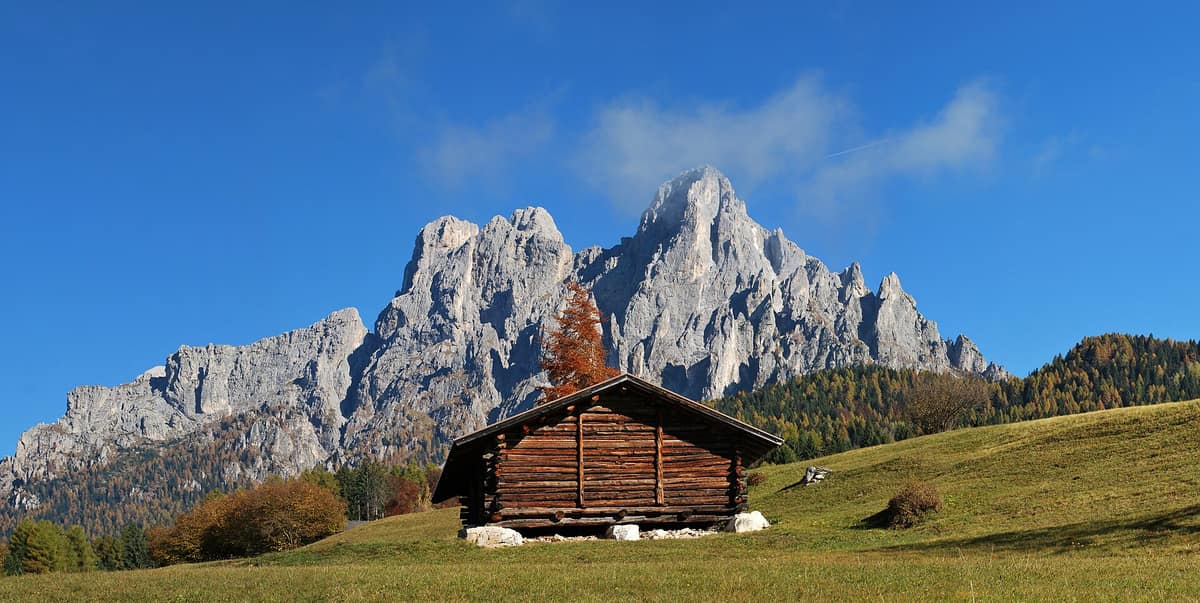
The 'Forest of the Violins' (resonance spruce harvested by Stradivarius) beneath the spectacular dolomitic spires of the Pale di San Martino.
The world's most famous violins were born in an Alpine forest. Historic master luthiers sought out resonance spruce in Paneveggio, an ocean of Norway spruce known today as the Forest of the Violins, celebrated for furnishing tonewood for stringed musical instruments. The Paneveggio - Pale di San Martino Natural Park protects this legendary forest and, soaring above it, the jagged dolomitic towers of the Pale di San Martino: passing from deep forest green to pale gleaming rock in eastern Trentino, rising from just under 1.100 m to roughly 3.200 m.
What makes it unique
In a single day you can walk from the forest that provided the tonewood for celebrated violins to the oldest rock strata in the Dolomites, while observing red deer right by the visitor centre gate.
The place
Nature
The landscape
The park spans three valleys—Primiero, Val di Fiemme, and Val di Fassa—organized around the watersheds of the Cismon, Vanoi, and Travignolo torrents. To the east rise the Pale di San Martino, an immense dolomitic massif; to the west lie the rugged porphyry crests of the Lagorai chain, characterized by dark volcanic walls, sharp arêtes, and extensive blockfields. Two contrasting geological realms shaping two distinct landscapes and plant worlds.
Rock strata tell the story: here outcroppings display the oldest rocks in the entire dolomitic sequence. The Bellerophon formation holds dark fossiliferous limestones, including the eponymous marine gastropod. Above it, the massive, pale Sciliar Dolomite settled some 200 million years ago, accumulating nearly a thousand metres in thickness to form the sheer ramparts of Cimon della Pala and the Pale di San Martino. The Valles–Venegia geological trail helps visitors interpret local sedimentary strata and glacial moraines.
Forest belts reflect altitude. Between 1.500 and 1.900 m, Norway spruce comprises 85 % of the canopy, forming the historic state forest of Paneveggio spanning over 2.700 hectares. Higher up to about 2.200 m, European larch and Swiss stone pine dominate. Above the tree line thrive alpine pastures sheltering endemics confined to the Dolomites, such as Campanula morettiana, Primula tyrolensis, Saxifraga facchini, and Rhizobotrya alpina—endemic not merely at species level but as an entire genus. Lichens represent another treasure: some 650 species are known, with estimates suggesting at least a thousand.
Wildlife and seasons
The red deer is the emblem of the park; its modern presence stems from an accidental release: a few individuals escaped from a fenced enclosure in Paneveggio in 1963, successfully recolonizing the valley. Today, a dedicated enclosure beside the visitor centre allows close observation. The roe deer is distributed throughout lower woodlands, the chamois populates high crags, and in 2000 a reintroduction programme re-established the alpine ibex on the Pale di San Martino with the release of thirty individuals.
High alpine meadows shelter the alpine marmot, which excavates extensive burrow networks; colonial sentinels sound differentiated whistles depending on whether danger approaches from the skies or on land. Above 1.300 m live mountain hares, alongside stone martens and the more forest-dependent European pine marten.
Avian life numbers over 80 breeding species. Outstanding galliformes include the western capercaillie—the largest Italian grouse—and the black grouse; rock ptarmigan dwell in the high tundra and hazel grouse in mixed woods. The Eurasian eagle-owl and golden eagle rule the skies as apex predators. Five owl species occur here, while woodpeckers feature the rare three-toed woodpecker and the black woodpecker. In hay meadows breeds the corncrake, showing early signs of recovery.
Cold streams and tarns yield unexpected species: alpine salamanders are found across high screes, while alpine newts inhabit glacial pools. Streams host marble trout and brown trout, with Arctic char in high tarns. At Laghetto Welsperg in Val Canali, native white-clawed crayfish thrive thanks to active conservation.
Species
With a page in the atlas
Being mentioned in a source doesn't guarantee sightings: check with the people who manage the area.
Memory and protection
History and conservation
The park was created in 1967 encompassing 15.704 hectares, expanded in 1987 by 4.007 hectares to its present extent of 19.726,09 hectares. It is structured into management zones: the integral wilderness reserve, subject to strict protection, covers 39,82 % where only scientific research and limited traditional grazing are permitted. The Pale di San Martino were inscribed as part of the UNESCO Dolomites World Heritage Site on 26 June 2009 in Seville.
Human history marks the landscape: two Austro-Hungarian forts from World War I stand at Forte Buso and Forte Dossaccio. In late October 2018, Storm Vaia devastated woodland across more than 650 hectares of the park.
Before you set off
Visiting
How to visit
The park has three visitor centres, each serving as a gateway. The Centro Terra Foresta in Paneveggio, on the road from Predazzo to Passo Rolle, is the entrance from Val di Fiemme: it tells the story of the Forest of the Violins and woodland animals, with an enclosure beside the centre where deer can be observed. From it departs the Sentiero Marciò, an interpretive loop with observation points that can be walked year-round, is undemanding, barrier-free except when there is snow or ice, and crosses a covered wooden bridge over the Travignolo and a suspension bridge over the gorge, where the torrent forms rapids and waterfalls. In summer and winter, accompanied outings are organized.
Villa Welsperg in Val Canali, dating from 1853, is the entrance from Primiero and the park headquarters; here is the visitor centre dedicated to protected areas, the park territory, and alpine aquatic life, surrounded by the «Percorso delle muse Fedaie», a flat and barrier-free loop for all exploring biodiversity. The San Martino di Castrozza centre focuses on the high-mountain environment, the geology of the Dolomites, and the golden eagle.
For longer walks, the Sentiero Etnografico del Vanoi links Caoria, at 845 m, and malga Vesnòta de sora, at 1.879 m, along four themed itineraries. The Caoria-Paneveggio cycle-pedestrian route covers almost 36,5 kilometres along existing forest roads and trails, and the SS 50 state highway connects the Paneveggio centre with Predazzo and Passo Rolle. The park also organizes walking and snowshoe excursions and environmental workshops.
Before you go
Guided walks and ranger outings are scheduled throughout the summer and winter seasons; verify programme details in advance. In snowy or icy conditions, the Sentiero Marciò is no longer barrier-free.
Check access, rules and visiting conditions in the official information from the managing body before you set off.
Location
Where it is and how far it reaches
Boundary of Parco naturale Paneveggio - Pale di San Martino · IUCN IV · © EEA, CDDA (CC-BY) The coordinate is estimated; it isn't a verified access point.
Transparency
Sources
The research data with its sources, and the official links for this place, are in the Spanish version of this page. See the Spanish version
Around it
The Parco Nazionale delle Dolomiti Bellunesi lies about five kilometres away, and Val Canzoi (Dolomiti Bellunesi Wilderness Sector) twelve kilometres away. Twenty-three kilometres away sits Parco Naturale Puez-Odle / Naturpark Puez-Geisler, and twenty-seven kilometres away Parco Naturale Fanes-Sennes-Braies / Naturpark Fanes-Sennes-Prags.
What else to explore nearby
Approximate straight-line distance between the edges of each area. It doesn't indicate access, routes or driving times.
- Belluno Dolomites National Park
Veneto (Belluno / Feltre / Agordo)
About 5 km away
The wildest and southernmost sector of the Dolomites (UNESCO World Heritage), carved by deep karst ravines such as the Cadini del Brenton.
JFMAMJJASONDMay – October · Crowding very low
- Puez-Odle Natural Park / Naturpark Puez-Geisler
South Tyrol (Val Gardena / Val di Funes / Santa Cristina)
About 23 km away
The razor-sharp dolomitic spires of the Odle/Geisler towering above the alpine pastures of Val di Funes.
JFMAMJJASONDJune – October · Crowding moderate
- Fanes-Sennes-Braies Natural Park
South Tyrol / Alto Adige (San Vigilio di Marebbe / Val Badia / Lago di Braies)
About 27 km away
The idyllic turquoise waters of Lago di Braies and the desolate karst plateaus of Fanes and Sennes encircled by dolomitic amphitheatres.
JFMAMJJASONDJune – October · Crowding moderate
If you like this place, elsewhere in Europe
Distant places with uncommon wildlife and habitats in common. The most widespread species don't count. Sharing species doesn't imply a corridor or guaranteed presence.
- Retezat National Park
Hunedoara County (Hațeg)
In common: Martes foina · European pine marten · Western capercaillie — high mountain, old-growth forest
The realm of the granitic and glacial Retezat, with over 80 crystal tarns and the Gemenele scientific reserve.
JFMAMJJASONDJune – October · Crowding low
- Mount Olympus National Park
Pieria / Larissa (Litochoro)
In common: Martes foina · Chamois — high mountain, old-growth forest
Greece's inaugural national park (1938): the country's highest peak, incised by the Enipeas Gorge and renowned for endemic flora.
JFMAMJJASONDJune – October · Crowding moderate
- Sierra Nevada National and Natural Park
Andalusia (Granada / Almería / Capileira / Trevélez / Monachil)
In common: Martes foina — high mountain, karst and caves, old-growth forest
The roof of the Iberian Peninsula (Mulhacén 3,479 m and Veleta 3,396 m), a Biosphere Reserve with over 80 exclusive endemic plant species.
JFMAMJJASONDMay – October · Crowding moderate
Entry #538 of the original atlas.