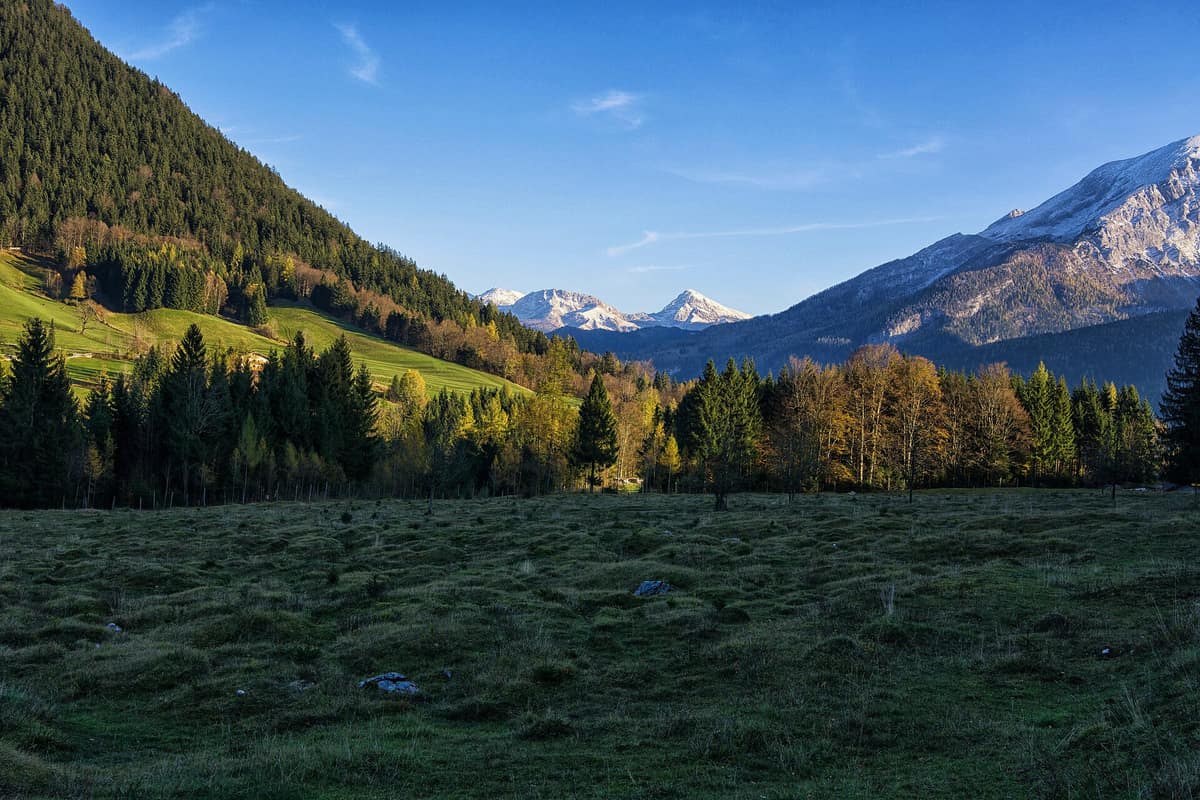
Berchtesgaden National Park - Hagengebirge Massif
Nationalpark Berchtesgaden - Hagengebirge
Bavaria (Berchtesgaden) (DE) / Salzburg (AT) · Germany / Austria
Photo: Andreas Gräwe · CC BY-SA 4.0 · Wikimedia Commons
Germany's only high-alpine National Park, dominated by mount Watzmann (2.713 m) and the fjord-like Königssee.
It begins at the bed of an alpine lake and rises to 2713 m. Berchtesgaden National Park, Germany’s only high-alpine national park, ranges from 603,3 m at the Königssee up to the jagged summit of the Watzmann, encompassing open water, dense forest, alpine pastures, and stark limestone crags across that immense gradient. Designated on 1 August 1978, it covers 208 km² in the Berchtesgaden Alps abutting the Austrian border. Within its boundaries lies the Bavarian sector of the Hagengebirge, a hollowed limestone massif whose western drop falls some 1700 m directly into the Königssee.
What makes it unique
A limestone massif honeycombed with almost 500 caves, including a 55 km system, plunging 1700 m to an alpine lake.
The place
Nature
The landscape
The Hagengebirge is composed of Dachstein limestone, with bedded limestone to the north and reef limestone to the south, forming a hollow labyrinth: almost 500 caves are known, with some 450 thoroughly explored. The most famous is the Tantalhöhle, extending over 34 km; the interconnected Tantalhöhle-Jägerbrunntrog system reaches 55 km, and the Wildpalfen system inside the park spans 6 km. Most of the massif lies within Salzburg, with its western fourth in Bavaria.
Beyond the Hagengebirge, the park preserves contrasting mountain landforms. The Wimbachgries, sandwiched between Watzmann and Hochkalter, is an extraordinary debris-filled valley choked with up to 300 m of limestone gravel along ten kilometres. At the high mountain lake Funtensee, the lowest winter temperatures in Germany are routinely recorded. The park also cradles the Watzmann, the Blaueis glacier, and the larger portion of the Königssee.
Wildlife and seasons
The golden eagle reigns supreme here. The Klausbachtal is aptly nicknamed the valley of the eagles: it offers the highest probability in the park of watching a golden eagle in the wild, being home to one of four resident pairs, and with luck can be observed all year round. The bearded vulture can be observed at close quarters at the Halsgrube information station until mid-October.
Mammals include roe deer, red deer, chamois, Alpine ibex (reintroduced in the thirties), and, among smaller species, Alpine marmot, mountain hare, and European snow vole. Beginning in 1924, ibex were released on the Austrian side and from 1936 at Röth; today they form an established colony roaming the southern Berchtesgaden Alps. Around 100 bird species breed here, notably western capercaillie, rock ptarmigan, alpine chough, and wallcreeper. There are 16 species of amphibians and reptiles, including the alpine salamander, while the Rosalia longicorn and Apollo butterfly are characteristic mountain insects.
The original fauna once included bison, lynx, brown bear, wolf, and otter; no active reintroductions are planned, though some could recolonise naturally.
Species
With a page in the atlas
Being mentioned in a source doesn't guarantee sightings: check with the people who manage the area.
Memory and protection
History and conservation
In 1910 a botanical reserve for alpine flora of roughly 83 km² was created, and in 1921 the Königssee reserve was established following protests against carving a stone lion into the Falkenstein cliff. On 1 August 1978 the national park was formally gazetted, halting controversial plans for a cable car up the Watzmann. The park forms the core zone of 139 km² and the buffer zone of 69 km² within the 467 km² UNESCO biosphere reserve. Across the Hagengebirge, of the 27 historical alpine pasture settlements that once operated, almost all are abandoned and ruined today, except Graz and Angeralm.
Before you set off
Visiting
How to visit
The Haus der Berge, the central visitor centre, provides interactive exhibitions, a cinema showing a panoramic film of the Berchtesgaden Alps, temporary displays across two floors, the «Mensch & Berg» showcase, and a library. Its core exhibition Vertikale Wildnis spans around 1.000 m², ascending from the bottom of Königssee through aquatic, forest, alpine meadow, and bare rock zones up to the summits, culminating in a 12-minute nature film projected on an 11 × 15 m screen. Outside, the Panoramaweg introduces four mountain habitats facing Watzmann, Hochkalter, and Jenner. It opens daily from 9.00 to 17.00, with last exhibition admission at 16.00, and about three hours are recommended.
The park maintains 260 km of footpaths, ranging from barrier-free paths to demanding alpine routes, graded into accessible, easy, moderate, and difficult. Blue trails are narrow and can be steep without falling risks; black trails are narrow, steep, and exposed, with fall hazards. For eagle viewing, the observation point lies roughly 20 minutes on foot from Klausbachhaus, complete with panels explaining golden eagle biology, hunting strategies, and telemetry monitoring. The bearded vulture observation post is situated just over 60 minutes along trail 472 toward Halsalm, where staff answer questions daily from 10 to 16 until mid-October in fair weather. The Schneibstein is reached easily from the Jennerbahn mountain terminal, and Seeleinsee below Kahlersberg is a classic hiking destination. Free ranger-led walks are available, with guided winter snowshoeing highly recommended.
Before you go
Flying drones, camping, or bivouacking outdoors is strictly prohibited, and bicycles are permitted exclusively on authorised tracks. Dogs must be kept on a leash, cutting across switchbacks or leaving trails is banned, and all litter must be carried out. Camping is forbidden everywhere, including Salet, Kessel, and St. Bartholomä on Königssee, where stranded visitors after boat services end are retrieved by emergency patrol boat at high cost. Rangers patrol year-round and fine offenders. Long alpine treks demand a good head for heights, sure-footedness, and stamina; in winter avalanche bulletins must be consulted. The Austrian side of the Hagengebirge is remote and rugged, and during the autumn hunting season from September to December hikers are unwelcome.
Check access, rules and visiting conditions in the official information from the managing body before you set off.
Location
Where it is and how far it reaches
Boundary of Berchtesgaden · IUCN II · © EEA, CDDA (CC-BY) The coordinate is estimated; it isn't a verified access point.
Transparency
Sources
The research data with its sources, and the official links for this place, are in the Spanish version of this page. See the Spanish version
How it fits into the territory
Calculated from the Atlas boundaries. «Part of» is only stated with an official boundary; an estimated area only means that they overlap.
Shares territory with
- Steinernes Meer - Sea of Stone
Bavaria (DE) / Salzburg (Saalfelden / Maria Alm) (AT)
Their official boundaries overlap
The 'Sea of Stone', a vast undulating desert-like limestone plateau suspended at 2.000 m altitude straddling Germany and Austria.
JFMAMJJASONDJune – October · Crowding low
Around it
The Steinernes Meer Karst Plateau lies some 2 km away, and the Tennengebirge Karst Plateau is about 10 km distant. With Karwendel Nature Park, Vanoise National Park, Gran Paradiso National Park, and Adamello-Brenta Nature Park, Berchtesgaden shares the Alpine ibex, and with the first three, the golden eagle.
What else to explore nearby
Approximate straight-line distance between the edges of each area. It doesn't indicate access, routes or driving times.
- Tennengebirge Karst Plateau
Salzburg (Werfen / Abtenau)
About 10 km away
Alpine limestone plateau rimmed by precipitous escarpments housing Eisriesenwelt, the largest explored ice cave on Earth (42 km of surveyed passages).
JFMAMJJASONDJune – October · Crowding low
- Ankogel Group - Hohe Tauern
Carinthia / Salzburg (Mallnitz / Bad Gastein)
About 21 km away
The 'Gateway to the Tauern', crystalline massif of the Ankogel (3,252 m) with retreating glaciers and pristine alpine alluvial valleys.
JFMAMJJASONDJune – October · Crowding low
If you like this place, elsewhere in Europe
Distant places with uncommon wildlife and habitats in common. The most widespread species don't count. Sharing species doesn't imply a corridor or guaranteed presence.
- Écrins National Park - Alpine Massif
Auvergne-Rhône-Alpes / Provence-Alpes-Côte d'Azur (Isère / Hautes-Alpes)
In common: Alpine ibex · Golden eagle — high mountain, glacial landscape
The glaciated core of the French Alps (Barre des Écrins 4.102 m), with deep glacial valleys such as Valgaudemar and Vénéon.
JFMAMJJASONDJune – October · Crowding low
- Karwendel Nature Park
Tyrol (Innsbruck / Scharnitz) (AT) / Bavaria (Mittenwald) (DE)
In common: Alpine ibex · Golden eagle — high mountain, karst and caves
Tyrol's largest Nature Park, with 4 parallel limestone ranges plunging sheer into gorges and the famous ancient sycamore-maple wood-pasture Großer Ahornboden.
JFMAMJJASONDJune – October · Crowding low
- Vanoise National Park
Auvergne-Rhône-Alpes (Savoie)
In common: Alpine ibex · Golden eagle — high mountain, glacial landscape
France's first national park (1963), created to save the Alpine ibex: glaciers, alpine grasslands, and one of the Alps' greatest ibex populations.
JFMAMJJASONDJune – September · Crowding moderate
- Maritime Alps Natural Park
Piedmont (Cuneo / Valdieri / Entracque)
In common: Alpine ibex · Golden eagle — high mountain, glacial landscape
United with France's Mercantour National Park, it forms a massive cross-border Alpine-Mediterranean wilderness crowned by Mount Argentera (3.297 m).
JFMAMJJASONDJune – October · Crowding low
Entry #352 of the original atlas.